
For more than half a century, George Lucas has transformed the way stories are told through film. With the Star Wars saga, he redefined the modern blockbuster, while Indiana Jones revived the timeless appeal of cinematic adventure, inspiring generations of filmmakers, illustrators, comic book artists, and visual creators. Yet the project Lucas considers the most personal of his career is not a movie—it is a museum.
After more than 15 years of planning, site changes, legal disputes, pandemic-related delays, and an investment exceeding $1 billion, the Lucas Museum of Narrative Art (LMNA) will officially open to the public on September 22, 2026, in the historic Exposition Park in the heart of South Los Angeles.
Despite what many might expect, this is not a museum devoted solely to the Star Wars universe. Instead, the Lucas Museum embraces a far broader vision: to explore the central role that images have played in shaping human civilization and to demonstrate how visual storytelling has become one of humanity’s most universal forms of communication.
Paintings, photography, comic books, illustrations, children’s books, posters, storyboards, film concept art, digital artworks, and iconic artifacts from cinema history come together under one roof, united by a simple yet powerful idea: every image tells a story.
Home to more than 40,000 works, the museum occupies a striking building designed by architect Ma Yansong of MAD Architects, set within a completely reimagined landscape created by landscape architect Mia Lehrer. Together, they establish the Lucas Museum as one of the most significant new cultural institutions in the United States—and the world’s first museum dedicated entirely to the art of visual storytelling.
The Lucas Museum of Narrative Art is built around a deceptively simple yet profound question: What is a story?
For George Lucas, the answer extends far beyond cinema or literature. For thousands of years, humanity has understood and shared its world through images. From prehistoric cave paintings and Roman mosaics to Renaissance frescoes, illustrated books, comic books, photography, and film, every era has used visual storytelling to preserve ideas, beliefs, and shared experiences.
What unites these diverse artistic traditions is their ability to communicate emotions, values, memories, and cultural identity through visual language.
This philosophy is reflected in the museum’s curatorial approach. Rather than organizing its collection according to conventional art historical categories, the Lucas Museum brings together works from different periods, cultures, and artistic disciplines, revealing how the impulse to tell stories through images has remained a defining characteristic of human civilization.
George Lucas captures this vision in one of the statements that best defines the museum’s mission:
“Narrative art tells the story of a society—what the common beliefs are that hold it together.”
In Lucas’s view, images are far more than aesthetic objects. They are cultural tools through which societies construct their identities, preserve collective memory, and pass shared values from one generation to the next.
This belief is the foundation of a museum that deliberately rejects the traditional divide between fine art and popular culture.
A painting by Frida Kahlo can be displayed alongside an original comic page by Jack Kirby. An illustration by Norman Rockwell may be presented next to a photograph by Dorothea Lange. A film storyboard can share gallery space with an illuminated manuscript or a contemporary graphic novel.
The goal is not to rank artworks according to historical prestige, but to highlight their shared ability to tell stories and illuminate the human experience.
The concept of Narrative Art lies at the very heart of the Lucas Museum.
Traditionally, museums have prioritized painting, sculpture, and the decorative arts, while comic books, illustration, advertising posters, and concept art were often dismissed as “commercial” or secondary forms of creative expression.
George Lucas has challenged that distinction throughout his life.
From an early age, he collected original comic book pages at a time when they held little commercial value. They were widely regarded as disposable publishing materials rather than works of art. Today, many of those same pieces are recognized as masterpieces of visual culture and command significant attention from museums and collectors worldwide.
Over the course of more than five decades, Lucas has assembled a collection that traces the evolution of visual storytelling, demonstrating that the boundary between fine art and popular culture is far more fluid than traditional art history has often suggested.
For Lucas, a comic strip by Winsor McCay, an illustrated book cover by N. C. Wyeth, a painting by Maxfield Parrish, a photograph by Henri Cartier-Bresson, or a Star Wars concept sketch all pursue the same essential goal: telling a compelling story through images.
As Lucas has often observed:
“Stories are mythology, and when illustrated, they help humans understand the mysteries of life.”
This philosophy makes the Lucas Museum of Narrative Art a truly unprecedented cultural institution—one where cinema enters into dialogue with painting, photography meets comic art, illustration stands alongside fine art, and every visual medium is recognized for its power to tell stories that shape the human experience.
To most people, George Lucas is synonymous with Star Wars and Indiana Jones. Far fewer know that long before becoming one of Hollywood’s most influential filmmakers, he was a passionate art collector.
His collecting journey began during his college years, when he purchased his first original comic book pages—works that, at the time, sold for just a few dozen dollars.
Lucas has often recalled that these were simply the only artworks he could afford.
Over the decades, however, that modest collection grew into one of the world’s most significant private holdings dedicated to visual storytelling, encompassing more than 40,000 works spanning fine art, illustration, comics, photography, cinema, and popular culture.
What makes Lucas’s collection especially distinctive is the deeply personal relationship he has with the artworks.
As he once explained:
“I could never sell my art. It just is not what I think art is. I think it’s more about an emotional connection with the work, not how much it cost.”
For Lucas, art is not a financial asset or an investment. It is a lifelong personal connection—one built on inspiration, meaning, and emotional resonance rather than market value.
That philosophy also explains why the museum came into being. Rather than allowing the collection to be dispersed through private sales or auctions, Lucas chose to create a permanent public institution where these works could be preserved, experienced, and appreciated by future generations, fulfilling the educational mission that has always been at the heart of his vision.
Alongside George Lucas, the Lucas Museum of Narrative Art bears the imprint of Mellody Hobson—business leader, philanthropist, President and Co-CEO of Ariel Investments, and former Chair of the Board of Starbucks.
Throughout her career, Hobson has become one of the most influential figures in American finance, serving on the board of directors of JPMorgan Chase while championing financial literacy, diversity, and inclusive leadership.
Her contribution to the Lucas Museum extends far beyond financial support.
From the earliest stages of the project, Hobson played a central role in shaping the museum’s cultural mission, helping to develop an institution grounded in education, inclusion, and the representation of diverse voices and lived experiences.
Her vision for the museum is encapsulated in one of its defining statements:
“This is a museum of the people’s art—the images are illustrations of beliefs we live with every day. For that reason, this art belongs to everyone.”
This philosophy reimagines the museum not as an exclusive institution for a privileged few, but as a welcoming public space where visual storytelling reflects the experiences, values, and aspirations shared across society.
By embracing art in all its forms—from masterpieces to popular culture—the Lucas Museum seeks to make cultural heritage more accessible, relevant, and meaningful for audiences of every generation.
The creation of the Lucas Museum of Narrative Art is also a reflection of its founders’ long-standing commitment to philanthropy.
In 2010, George Lucas and Mellody Hobson joined the Giving Pledge, the philanthropic initiative launched by Bill Gates and Warren Buffett, through which many of the world’s leading entrepreneurs and philanthropists commit to donating the majority of their wealth to charitable causes.
For Lucas and Hobson, the museum represents one of the most meaningful ways to give back to society.
As Hobson has explained:
“We’ve always said we’re simply stewards of society’s wealth, with the intention of giving it back. This museum is how we’ve chosen to do that.”
This belief is reflected throughout the institution’s mission. Beyond preserving an extraordinary art collection, the Lucas Museum is designed to expand access to arts education, celebrate creativity, and inspire future generations through the transformative power of visual storytelling.
By combining philanthropy, education, and culture, the museum stands as a lasting public legacy—one intended not only to showcase art, but also to enrich communities and make storytelling accessible to everyone.
The idea for the Lucas Museum of Narrative Art began to take shape in the early 2000s, when George Lucas started considering the future of his ever-growing art collection.
By then, the collection had expanded to include thousands of works spanning a remarkable range of disciplines, including American painting, editorial illustration, comic art, photography, film concept art, and a wealth of original materials from Lucasfilm productions.
Lucas’s ambition was never simply to preserve these works. Instead, he envisioned a new kind of cultural institution—one that would redefine what a museum could be and challenge traditional ideas about art, storytelling, and visual culture.
In 2013, Lucas officially unveiled the project and began searching for a permanent home.
The first proposal focused on the San Francisco Bay Area, a region deeply connected to both his personal life and professional legacy through Skywalker Ranch and Lucasfilm.
Attention later shifted to Chicago, a city with which Lucas shared strong personal ties. There, MAD Architects developed an ambitious design for a museum on the shores of Lake Michigan.
The proposal, however, faced sustained opposition from environmental organizations and civic groups concerned about the use of public lakefront land. After years of legal disputes and public debate, Lucas formally abandoned the Chicago project in 2016.
The breakthrough came in 2017, when the City of Los Angeles offered a more than 10-acre site within Exposition Park, one of California’s premier cultural destinations.
Construction officially began the following year, transforming a vision more than a decade in the making into a tangible reality.
Se la collezione rappresenta il cuore del Lucas Museum of Narrative Art, la sua architettura costituisce senza If the collection is the heart of the Lucas Museum of Narrative Art, its architecture is undoubtedly the most visible expression of the philosophy behind the entire project. From the very first design renderings, the building captured the attention of architects, critics, and design enthusiasts alike, establishing itself as one of the most distinctive examples of contemporary museum architecture.
The museum was never intended to be merely a container for works of art. Instead, it was conceived as a three-dimensional narrative in its own right—an architectural experience designed to inspire emotion and spark the imagination long before visitors step inside the exhibition galleries.
This vision perfectly reflects George Lucas’s belief that a museum dedicated to some of the world’s greatest works of narrative art should possess an expressive power equal to that of the collection it houses.
Lucas summarized this philosophy in a statement that has become one of the defining quotations associated with the project:
“This art is important. Let’s put it in an important building.”
What might appear to be a simple remark actually encapsulates the museum’s entire mission: to place painting, comic art, illustration, photography, cinema, and other forms of visual storytelling on equal artistic footing, while celebrating them within a landmark building destined to become a cultural icon in its own right.
Per trasformare questa idea in realtà, George Lucas e Mellody Hobson hanno scelto uno degli architetti più To bring this ambitious vision to life, George Lucas and Mellody Hobson selected one of the world’s most innovative architects: Ma Yansong, founder of the Beijing-based firm MAD Architects.
Born in Beijing in 1975, Ma is widely recognized as one of the leading voices of contemporary architecture. After studying at the Beijing University of Civil Engineering and Architecture and completing further studies at Yale University, he founded MAD Architects in 2004. Within just a few years, the practice gained international recognition for a design philosophy that challenged many of the conventions of Western architecture.
Rather than focusing solely on function, MAD Architects seeks to create buildings that establish an emotional connection with the people who experience them. In place of rigid geometries and purely rational forms, the studio embraces flowing volumes, seamless surfaces, and organic shapes inspired by nature.
Over the years, MAD has designed some of the world’s most recognizable contemporary buildings, including the Absolute Towers in Canada, the Harbin Opera House, the Quzhou Sports Campus, the Gardenhouse residential complex in Beverly Hills, and numerous cultural projects across Asia, Europe, and North America.
The Lucas Museum of Narrative Art is one of MAD Architects’ most significant projects in the United States and the culmination of a creative collaboration between Ma Yansong and George Lucas that has spanned more than fifteen years.
Ma has often described his relationship with Lucas as remarkably intuitive:
“Sometimes I don’t need words to explain. He can just feel it.”
That creative understanding made it possible to develop a museum in which architecture and cultural purpose are inseparable. Rather than simply housing a collection, the building itself becomes part of the storytelling experience, embodying the museum’s mission through its form, atmosphere, and emotional impact.
To fully understand the Lucas Museum of Narrative Art, it is essential to explore one of the core principles behind Ma Yansong’s architectural vision: the concept of the Shanshui City.
Derived from the Chinese artistic tradition, shanshui literally translates as “mountain and water.” In classical Chinese landscape painting, it represents an ideal of harmony between humanity and nature, where the landscape is not merely a backdrop but a living presence that shapes human experience.
Applied to contemporary architecture, this philosophy envisions cities in which buildings, public spaces, and the natural environment coexist as a seamless whole rather than as separate elements.
According to Ma Yansong, many modern urban environments are dominated by rigid geometries, artificial surfaces, and monumental structures that weaken the relationship between people and nature. His architecture seeks to restore that connection through flowing forms, continuous surfaces, and the careful integration of buildings into the surrounding landscape.
The Lucas Museum is perhaps one of the most fully realized expressions of this philosophy.
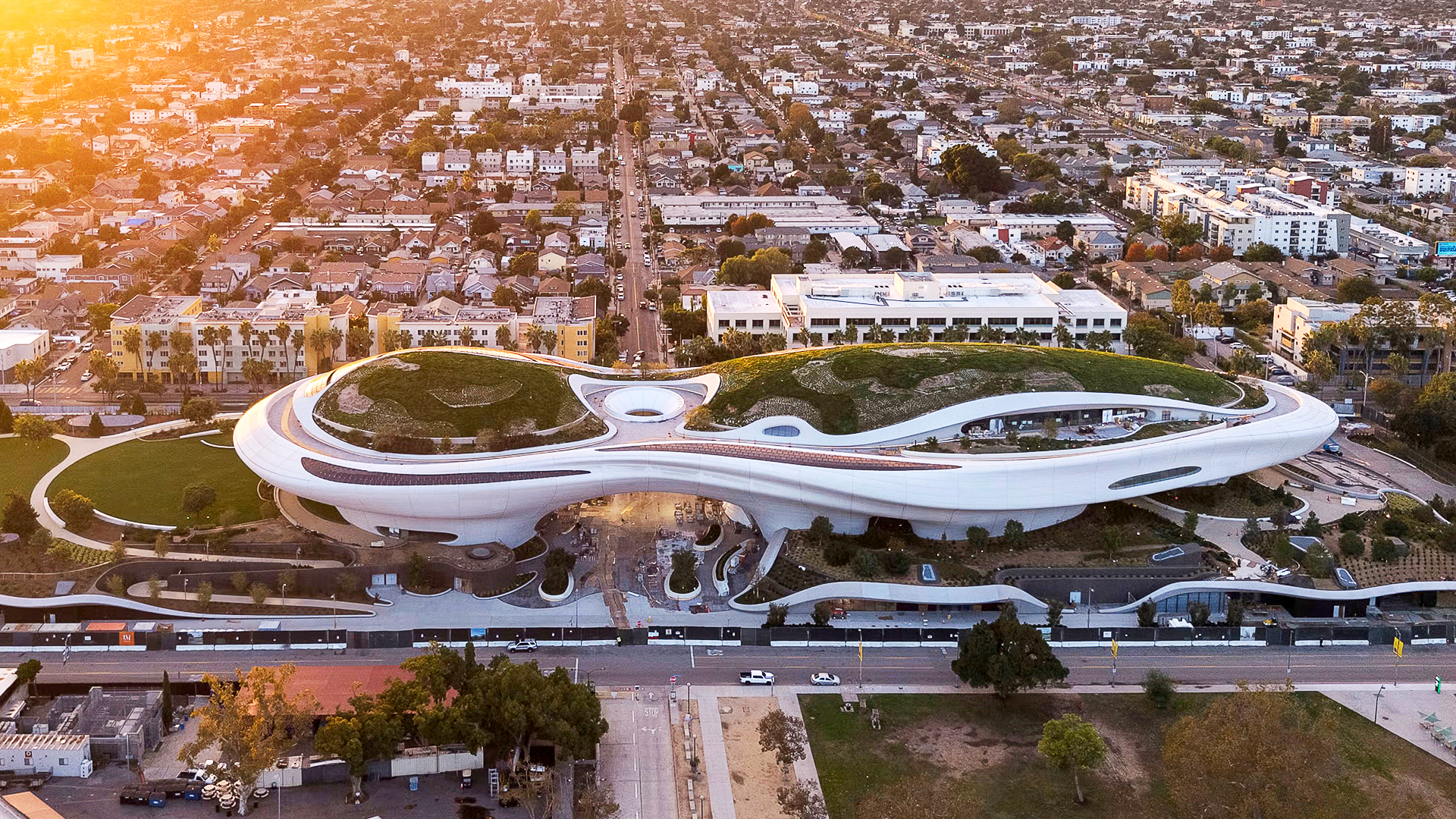
Rather than imposing itself on the urban fabric, the building appears to emerge organically from the ground—more like a natural landform than a conventional museum. Its sculptural silhouette evokes a wind-shaped hill or a cloud gently hovering above the park, creating an architecture that feels fluid, dynamic, and deeply connected to its environment.
Ever since the first renderings were unveiled, many observers have compared the Lucas Museum of Narrative Art to a gigantic spaceship that has landed in the heart of Los Angeles.
Given George Lucas’s lifelong association with science fiction, the comparison is understandable.
Yet Ma Yansong has consistently emphasized that the building’s primary inspiration did not come from Star Wars or any other cinematic universe. Instead, its design emerged from a close observation of the natural landscape surrounding Exposition Park.
The museum draws inspiration from three defining elements of its setting:
Rather than imitating a man-made object, the building is intended to evoke a natural presence—an organic form that changes continuously with shifting light, weather conditions, and the viewer’s perspective.
Its sweeping curved surfaces reflect both the sky and the surrounding vegetation, softening the building’s visual mass and creating the impression that it is almost in motion.
This effect is further enhanced by the near-total absence of sharp corners and straight lines, a bold design choice that sets the Lucas Museum apart from the conventions of traditional museum architecture.
One of the most striking features of the Lucas Museum of Narrative Art is the way it engages with the landscape beneath it.
Rather than occupying the entire site, the building is elevated at its center, creating a vast covered public space that serves as both the museum’s main entrance and a welcoming urban plaza.
This architectural solution delivers several important benefits.
First, it preserves visual continuity across Exposition Park, ensuring that the museum enhances rather than interrupts the surrounding landscape.
Second, it creates a generous shaded gathering space designed for community events, relaxation, and everyday public use, making the campus an inviting destination even for those who are not visiting the museum’s galleries.
Finally, the elevated structure reinforces one of the building’s most remarkable qualities: its extraordinary sense of lightness.
Although the museum spans approximately 28,000 square meters (300,000 square feet) across five levels, its sculptural form appears to hover above the landscape, transforming a monumental building into a dynamic and welcoming presence within the park.
The site chosen for the Lucas Museum of Narrative Art tells a remarkable story of urban transformation.
Before construction began, the land was occupied by a large asphalt parking lot serving visitors to Exposition Park.
The project has completely reimagined that space.
Today, the museum occupies an 11-acre (approximately 45,000-square-meter) site that has been transformed into a vibrant cultural and landscaped destination, returning a significant area of public space to the city.
As a result, the Lucas Museum is more than a new cultural institution—it is a catalyst for urban regeneration, redefining the relationship between the surrounding neighborhood and one of Los Angeles’ most important public parks.
The redevelopment introduces new pedestrian connections, strengthens links with neighboring cultural institutions, and significantly expands the park’s green spaces, creating a more accessible and welcoming environment for both local residents and visitors.
From an engineering perspective, the construction of the Lucas Museum of Narrative Art presented an extraordinary technical challenge.
To achieve the seamless sculptural form envisioned by Ma Yansong, the design team developed an advanced exterior cladding system composed of more than 1,500 custom-made curved panels crafted from FRP (Fiberglass Reinforced Polymer)—a high-performance composite material that combines lightweight polymers with glass-fiber reinforcement.
FRP was selected for several reasons. In addition to offering exceptional strength, durability, and weather resistance, the material allows architects to create highly complex, free-flowing geometries while remaining significantly lighter than many conventional façade systems.
Perhaps the most remarkable aspect of the project is that no two panels are identical.
Each component was individually designed, digitally modeled, and precisely manufactured with its own unique curvature and exact position within the building envelope. Together, they create a continuous architectural skin with no visible interruptions, reinforcing the museum’s fluid, organic appearance.
The result is a façade that appears to have been shaped by natural forces rather than assembled from industrial components. Throughout the day, its smooth white surfaces interact with changing sunlight, casting shifting reflections and subtle shadows that make the building feel almost alive.
The overall effect is a museum that defies the conventions of traditional civic architecture. Rather than presenting itself as a static, monumental object, the Lucas Museum becomes a dynamic, biomorphic landmark—one that remains in constant dialogue with the sky, the lush landscape of Exposition Park, and the vibrant life of Los Angeles.
The architecture of the Lucas Museum of Narrative Art cannot be fully understood without considering the inseparable relationship between the building and its landscape. From the earliest stages of the project, George Lucas and Ma Yansong envisioned the museum not as an isolated landmark, but as an integral part of Exposition Park, one of Los Angeles’ most important cultural districts.
To realize that vision, the landscape design was entrusted to Mia Lehrer, founder of Studio-MLA and one of the leading figures in American landscape architecture. Her work goes far beyond surrounding the museum with ornamental gardens. Instead, it redefines the relationship between architecture, nature, and public space, creating a campus that is as much a civic destination as it is a cultural institution.
The landscape project spans more than 11 acres (approximately 4.5 hectares), transforming what was once an asphalt parking lot into a continuous network of lawns, native plantings, tree-lined pathways, public plazas, and inviting gathering spaces.
The transformation carries powerful symbolic meaning. A site that served automobiles for decades has been returned to the public as a place dedicated to culture, community, and outdoor life.
The entire campus is conceived as a seamless extension of Exposition Park. Rather than drawing sharp boundaries between museum and park, the design intentionally blurs them, encouraging visitors and local residents alike to enjoy the outdoor spaces as a vibrant new urban park—even without entering the museum itself.
In the design of the Lucas Museum of Narrative Art, the landscape is not a secondary or purely decorative element. On the contrary, it is a fundamental component of the visitor experience.
Mia Lehrer developed a network of pathways that guides visitors toward the building through a carefully choreographed sequence of open spaces, tree-lined areas, and places for rest and reflection. The goal is to create a gradual transition between the urban environment and the museum’s world of visual storytelling, preparing visitors for an immersive cultural experience even before they enter the galleries.
The landscape plan includes the planting of more than 200 new trees, selected from species suited to the climate of Southern California and chosen to provide shade, support biodiversity, and help reduce the effects of urban heat islands. These are complemented by extensive green areas, native plant gardens, and water-efficient irrigation systems designed to minimize environmental impact.
One of the project’s most striking features is the rooftop garden integrated into the building’s design, extending the landscape of Exposition Park upward onto the museum itself. From certain viewpoints, vegetation appears to climb across the structure, reinforcing the impression of an architecture that rises naturally from the ground and merges with its surrounding environment.
The campus is further enhanced by an elevated pedestrian walkway, panoramic terraces, and numerous spaces designed for relaxation, reading, community gatherings, and outdoor events. Together, these elements transform the Lucas Museum grounds into an open and accessible destination an urban landscape where culture, nature, and public life come together.
The decision to build the Lucas Museum of Narrative Art within Exposition Park was far from accidental. For more than a century, this area has been one of Los Angeles’ most important cultural and scientific districts, home to some of the city’s most renowned institutions.
Within just a few hundred meters, visitors can find the Natural History Museum of Los Angeles County, the California Science Center, the California African American Museum, and the historic Rose Garden, as well as the nearby campus of the University of Southern California (USC).
The arrival of the Lucas Museum further strengthens this cultural ecosystem, creating a unique dialogue between different fields of knowledge: natural history, science, African American culture, higher education, and now the art of visual storytelling.
This concentration of cultural institutions positions Exposition Park as one of the most significant museum districts in the United States, comparable to internationally recognized cultural destinations such as Museum Mile in New York City and MuseumsQuartier in Vienna.
The Lucas Museum is therefore not conceived as an isolated architectural landmark, but as a vital part of a broader cultural network one that reinforces Los Angeles’ position as a global capital of creativity, storytelling, and the entertainment industry.
From the very beginning, the Lucas Museum of Narrative Art was conceived not as a traditional container for artworks, but as a dynamic cultural space designed to be experienced every day.
The building extends across five levels and offers approximately 300,000 square feet (nearly 28,000 square meters) of total space, including exhibition galleries, public areas, educational facilities, and visitor services.
At the heart of the museum are 35 permanent galleries, covering approximately 100,000 square feet (more than 9,300 square meters). Unlike many traditional museums, these spaces are not organized according to chronology or separated by artistic medium. Instead, they are structured around universal themes connected to the human experience.
The museum’s major thematic sections include:
This curatorial approach allows artworks from different periods, cultures, and visual languages to enter into conversation with one another, revealing how storytelling through images has always explored humanity’s most profound questions.
Visitors can move from a painting by Frida Kahlo to a comic by Chris Ware, from a photograph by Dorothea Lange to an original Star Wars concept sketch, following emotional and thematic connections rather than a rigid historical sequence.
In this way, the Lucas Museum presents visual storytelling as a shared human language one that transcends artistic categories and connects generations through the universal power of images.orio di Star Wars, seguendo connessioni emotive e tematiche anziché una rigida successione storica.
La missione del Lucas Museum va ben oltre la conservazione delle opere. L’edificio è stato progettato come un The mission of the Lucas Museum of Narrative Art extends far beyond the preservation and display of artworks. The building has been designed as a true multidisciplinary cultural hub, capable of hosting educational programs, public events, research initiatives, and community-focused activities.
Alongside its exhibition galleries, the museum includes:
This organization reflects a contemporary vision of the museum as an active cultural platform—one focused not only on displaying artworks, but also on encouraging participation, learning, creativity, and the creation of new knowledge.
The Lucas Museum is therefore conceived as a place where visitors do not simply observe stories from the past, but actively engage with the processes of imagination, storytelling, and artistic expression that continue to shape culture today.
One of the most refined aspects of the Lucas Museum of Narrative Art is the way its architecture interacts with natural light.
Large glazed surfaces along the building’s perimeter allow daylight to flow into the public areas, creating a continuous visual connection with the surrounding landscape. At the same time, the exhibition galleries are designed with carefully controlled lighting conditions, essential for preserving the most delicate artworks in the collection.
The interior journey is defined by fluid spaces with minimal abrupt transitions, guiding visitors through a sequence of environments with varying heights, perspectives, and openings. Stairs, ramps, and elevated walkways become an integral part of the experience, offering constantly changing views of the park, the city, and the museum’s different areas.
This emphasis on spatial continuity reflects once again the architectural philosophy of Ma Yansong, who believes that buildings should be experienced like landscapes to be explored rather than as a series of isolated rooms.
At the Lucas Museum, movement itself becomes part of the narrative: every path, viewpoint, and architectural transition is designed to encourage discovery, curiosity, and a deeper connection between visitors, artworks, and the surrounding environment.
Although the Lucas Museum of Narrative Art is best known for its striking architectural form, the project also incorporates a wide range of strategies focused on environmental sustainability.
The transformation of a vast asphalt parking lot into a landscape-rich cultural campus represents a major ecological improvement, helping to reduce the urban heat island effect and enhance the area’s microclimate.
The extensive use of trees, green spaces, and permeable surfaces also supports stormwater management, increases urban biodiversity, and improves the overall resilience of the site. Meanwhile, the museum’s green roof contributes to thermal insulation, helping regulate indoor temperatures and reduce energy consumption.
The project’s emphasis on pedestrian pathways, public spaces, and connections to public transportation reflects a broader commitment to sustainable mobility, encouraging visitors to access the museum through alternatives to private vehicles.
By integrating architecture, landscape design, and environmental responsibility, the Lucas Museum demonstrates how a major cultural institution can become not only a place for art and storytelling, but also a model for more sustainable urban development.
The Lucas Museum of Narrative Art sought to create a positive impact on its surrounding community not only after opening, but also throughout the construction process.
Working in partnership with Hathaway Dinwiddie, the City of Los Angeles, and numerous local organizations, the project established an employment initiative designed to support opportunities for county residents while promoting the participation of businesses owned by women, ethnic minorities, and veterans.
Overall, the construction phase involved more than 4,200 workers, with over 60% of them coming from Los Angeles County. The initiative was supported by workforce development programs, professional training opportunities, and collaborations with labor unions and organizations focused on strengthening the local workforce.
This approach reflects the founders’ broader vision: to create not only a major cultural institution, but also a project capable of generating lasting economic and social benefits for the surrounding community.
The Lucas Museum is therefore conceived as a place where storytelling extends beyond the artworks inside its galleries becoming part of a larger story about inclusion, opportunity, and urban transformation.
Even before its official opening, the Lucas Museum of Narrative Art has become part of the international conversation surrounding contemporary architecture. Its organic and instantly recognizable silhouette joins the Los Angeles skyline alongside other iconic cultural buildings, including the Walt Disney Concert Hall by Frank Gehry and the David Geffen Galleries at LACMA designed by Peter Zumthor.
Although emerging from a different architectural era, the museum shares with these landmarks a common ambition: to redefine the relationship between architecture, the city, and public space. The fluid form created by Ma Yansong does not seek to become a traditional monument, but rather an architecture capable of inspiring imagination, movement, and openness.
In this sense, the Lucas Museum of Narrative Art is not merely a home for an extraordinary collection dedicated to visual storytelling it is itself a story built into physical space.
Every curve, every pathway, and every connection with the surrounding landscape contributes to expressing the central idea behind the project: stories belong to everyone, and they can be told through countless forms of human creativity.
By transforming architecture into an immersive narrative experience, the Lucas Museum becomes more than a museum it becomes a new cultural symbol for Los Angeles and a landmark dedicated to the universal power of imagination.
If the architecture of the Lucas Museum of Narrative Art represents the physical expression of its philosophy, the museum’s permanent collection is the true heart of the institution. With more than 40,000 works, the museum houses one of the most significant and comprehensive collections of narrative art ever assembled—an extraordinary achievement built through over five decades of collecting by George Lucas, and more recently through his shared vision with Mellody Hobson and the museum’s curatorial team.
The remarkable scale of the collection is defined not only by the number of works it contains, but also by the extraordinary diversity of visual languages it brings together. Paintings, illustrations, comic art, photography, murals, illustrated books, movie posters, storyboards, concept art, costumes, production materials, and audiovisual works coexist within a single exhibition journey, united by one fundamental principle: every image has the power to tell a story.
This approach is what sets the Lucas Museum apart from many traditional cultural institutions. Rather than organizing artworks strictly by artistic medium, historical period, or academic classification, the museum presents them as interconnected elements of one vast human narrative that spans centuries, cultures, and creative disciplines.
For George Lucas, the value of an artwork does not depend solely on its academic recognition, historical status, or technical execution. Its true significance lies in its ability to communicate emotions, ideas, and collective memory.
A Renaissance painting, an original comic book page, a documentary photograph, or a film concept sketch can all possess the same artistic importance when they engage audiences through the power of visual storytelling.
By bringing together seemingly different forms of expression, the Lucas Museum challenges traditional definitions of art and reveals a deeper connection between creativity, culture, and the universal human desire to tell stories.
From its very beginning, the Lucas Museum of Narrative Art has sought to challenge one of the longest-standing distinctions in the art world: the separation between forms of expression considered “high art” and those often dismissed as secondary, commercial, or purely popular.
For decades, disciplines such as editorial illustration, comic art, film concept design, and children’s illustrated books remained largely absent from major museum collections, despite their profound influence on the collective imagination of millions of people around the world.
George Lucas has always viewed this divide as artificial.
A collector long before becoming a filmmaker, Lucas dedicated much of his life to preserving artworks that, despite their enormous cultural impact, were frequently overlooked by traditional critics and institutions. Many of the original comic pages he acquired during the 1960s and 1970s, for example, were once considered nothing more than production materials created for printing. Today, they are recognized as important works in the history of sequential art and visual culture.
The same applies to countless editorial illustrations that shaped the visual imagination of the 20th century, influencing how entire generations envisioned adventure, science fiction, mythology, fantasy, and everyday life.
The Lucas Museum gives these works the recognition they deserve, placing them alongside masterpieces of painting and photography without imposing traditional artistic hierarchies.
By bringing together fine art, popular imagery, and visual storytelling, the museum presents a broader definition of creativity—one in which every medium has the potential to capture human experiences, preserve cultural memory, and tell powerful stories.
La collezione del museo attraversa oltre duemila anni di storia dell’arte e della comunicazione visiva. Il percorso The collection of the Lucas Museum of Narrative Art spans more than two thousand years of artistic and visual communication history. The exhibition journey moves from ancient Roman mosaics and Renaissance paintings to contemporary forms of digital storytelling and cinematic expression.
This extraordinary chronological range reveals how the human desire to communicate stories through images has remained fundamentally constant across the centuries, even as artistic languages, techniques, and technologies have continuously evolved.
The collection includes:
This interdisciplinary approach reflects one of the museum’s central beliefs: visual storytelling does not belong to a single artistic category, but represents a universal language capable of connecting every form of creative expression.
By bringing together historical masterpieces, popular imagery, and contemporary media, the Lucas Museum illustrates how images have always shaped the way humanity understands itself, preserves memory, and imagines the future.
One of the most innovative aspects of the Lucas Museum of Narrative Art is the way its 35 permanent galleries are organized.
Unlike traditional museums, which often arrange artworks according to chronological periods, geographic origins, or artistic movements, the Lucas Museum structures its exhibition journey around the universal themes that define the human experience.
Each gallery focuses on a fundamental concept shared across cultures and generations, revealing the common stories that connect humanity throughout history.
The museum’s major thematic sections include:
This thematic organization allows visitors to discover connections between artworks created in vastly different periods and cultural contexts, revealing the remarkable continuity of the ideas explored through narrative art.
By moving beyond traditional categories, the Lucas Museum encourages viewers to see images not as isolated objects, but as chapters in a shared human story.
Walking through the galleries of the Lucas Museum of Narrative Art, visitors will encounter artistic conversations that would rarely take place in traditional museums.
A self-portrait by Frida Kahlo may enter into dialogue with the illustrations of Norman Rockwell, while the socially powerful photography of Dorothea Lange can be displayed alongside original comic strips by Charles M. Schulz from the beloved Peanuts series.
Works by African American artist Charles White, renowned for their powerful exploration of human dignity and resilience, can be experienced alongside the monumental murals of Judith F. Baca, creator of the iconic Great Wall of Los Angeles, or the heroic and inspiring imagery of Kadir Nelson, one of the most influential contemporary illustrators.
These pairings are not accidental. They reflect the museum’s broader mission to highlight emotional, cultural, and narrative connections rather than focusing solely on traditional artistic classifications or stylistic similarities.
By bringing together creators from different centuries, backgrounds, and mediums, the Lucas Museum reveals how diverse forms of visual expression can address the same universal themes: identity, struggle, hope, memory, imagination, and the shared human experience.
The Lucas Museum of Narrative Art features works by some of the most influential figures in the history of figurative art and visual storytelling.
Among the highlights of the collection is the presence of Frida Kahlo, whose deeply personal works demonstrate how autobiography can become a universal visual language capable of connecting with audiences across cultures and generations.
Alongside Kahlo are the iconic illustrations of Norman Rockwell, whose celebrated covers for The Saturday Evening Post captured everyday American life with remarkable empathy, detail, and emotional insight.
The collection also includes works by:
The presence of these artists reflects the museum’s expansive vision of art history—one in which classical traditions, popular culture, illustration, and contemporary storytelling exist side by side without artificial boundaries.
By placing renowned painters alongside influential illustrators and visual storytellers, the Lucas Museum presents a broader understanding of artistic achievement: one defined not only by technique or historical status, but by the enduring power of images to communicate human experiences.
One of the most distinctive aspects of the Lucas Museum of Narrative Art collection is the central role given to comic art.
Throughout his life, George Lucas has been a passionate collector of original comic artwork and has long considered comics one of the most sophisticated forms of visual storytelling.
The museum preserves works by some of the most influential figures in the history of comics, including:
The inclusion of these works represents a decisive recognition of comic art as an independent artistic discipline—not merely a form of commercial publishing, but a sophisticated medium capable of exploring complex ideas, emotions, and human experiences.
By placing original comic artwork alongside paintings, photography, and illustration, the Lucas Museum challenges traditional definitions of fine art and highlights the unique power of sequential images to tell stories, preserve cultural memory, and shape collective imagination.
A particularly rich section of the Lucas Museum of Narrative Art is dedicated to fantasy and science fiction illustration, a genre that played a fundamental role in shaping George Lucas’s own creative imagination.
Among the most significant works are the illustrations of Jean Giraud (Moebius), including Starwatcher II. Moebius is widely regarded as one of the artists who had the greatest influence on contemporary science fiction cinema, inspiring generations of filmmakers, designers, and visual creators.
Alongside his works, the collection features numerous illustrations from 20th-century fantasy literature, iconic publishing covers, original concept designs, and historical artwork that reveal the evolution of science fiction imagery long before the arrival of digital visual effects.
This section demonstrates that science fiction is far more than escapism or entertainment. It is a powerful creative language through which artists explore humanity’s relationship with technology, society, imagination, and the future.
By celebrating the artists who have shaped speculative worlds, the Lucas Museum highlights how fantasy and science fiction have become essential forms of visual storytelling capable of imagining possible futures while reflecting the hopes, fears, and questions of the present.
Photography holds a prominent place within the Lucas Museum of Narrative Art, where it is presented as one of the most powerful forms of visual storytelling.
The collection includes works by some of the greatest masters of photography, including Gordon Parks, Henri Cartier-Bresson, and Dorothea Lange artists whose images documented some of the most significant moments of 20th-century history.
Their photographs demonstrate how a single image can contain an entire narrative, becoming at once a historical record, a social document, and a work of art.
Alongside documentary photography, the museum presents fine art photography, photojournalism, and materials connected to the history of cinema, further expanding the institution’s vision of visual storytelling.
By bringing together images that capture personal experiences, social transformations, and cultural memory, the Lucas Museum highlights photography’s unique ability to preserve moments in time while revealing deeper truths about the human condition.
While the permanent collection of the Lucas Museum of Narrative Art explores the history of visual storytelling through paintings, photography, comics, and illustration, the Lucas Archives represent the institution’s cinematic core.
This extraordinary archive is one of the most important collections dedicated to the creative legacy of George Lucas and Lucasfilm, documenting more than four decades of filmmaking history through thousands of costumes, props, models, sketches, storyboards, concept artworks, and production materials.
For many visitors especially fans of science fiction, fantasy, and adventure cinema this will likely be one of the museum’s most anticipated sections. However, the Lucas Archives were not created simply as a display of memorabilia or a nostalgic celebration of Star Wars and Indiana Jones. Their purpose is far more ambitious: to reveal how cinematic stories are created and to make visible the complex creative process that transforms an initial idea into a finished film.
The museum invites audiences to experience cinema not only through the final screen image, but also through the work of illustrators, production designers, costume designers, model makers, visual effects artists, and concept creators professionals who often remain behind the scenes but whose contributions are essential in shaping the worlds audiences see on screen.
Through the Lucas Archives, filmmaking becomes a story in itself: a journey of imagination, collaboration, and artistic innovation that reveals how the worlds of cinema are built from the earliest sketches to the final frame.
The origins of the Lucas Archives date back to 1983, the year in which production was completed on Star Wars: Episode VI – Return of the Jedi. During that period, George Lucas recognized the importance of systematically preserving the creative materials generated throughout the filmmaking process.
At Skywalker Ranch in Marin County, California, an archive was established to safeguard everything that was traditionally at risk of being discarded or lost once a film production ended: costumes, props, miniatures, storyboards, concept paintings, production photographs, technical documents, and countless other materials.
What initially appeared to be an internal preservation project quickly evolved into one of the most comprehensive records of contemporary filmmaking history.
In 2013, with the official launch of the Lucas Museum of Narrative Art project, George Lucas decided to donate the entire archive to the new institution, making it one of the museum’s most important permanent collections.
This decision reflects the same philosophy that inspired the creation of the museum itself: transforming a private collection into a shared cultural resource, ensuring that future generations can explore, study, and experience the creative processes behind some of cinema’s most influential stories.
Although Star Wars is inevitably the most famous and recognizable part of the collection, the Lucas Archives encompass a much broader chapter of Lucasfilm’s creative history.
The archive includes production materials from:
The goal is not simply to document George Lucas’s career as a filmmaker, but to reveal the evolution of storytelling techniques, production design, visual development, and special effects that helped transform modern cinema.
Through sketches, models, costumes, and behind-the-scenes materials, the Lucas Archives offer a unique look at the creative journey behind filmmaking showing how ideas move from imagination to design, and ultimately become the cinematic worlds experienced by audiences around the globe.
One of the most fascinating aspects of the Lucas Archives is the opportunity to experience cinema from its earliest creative stages.
Before a character appears on screen, before a set is constructed, or a costume is created, every film goes through an extensive process of development in which illustrators and concept artists transform a director’s ideas and visions into visual forms.
For this reason, the archive preserves thousands of creative materials, including:
These materials allow visitors to follow, step by step, the creation of imaginary worlds such as those found in Star Wars, revealing how illustration and visual development played a fundamental role in shaping cinematic universes.
In this sense, the Lucas Archives perfectly complement the mission of the Lucas Museum of Narrative Art: to demonstrate that visual storytelling exists long before a camera begins filming and remains the foundation of every stage of cinematic creation.
By revealing the artistic processes hidden behind the final image, the archives celebrate the countless creators whose imagination transforms ideas into unforgettable stories.
Tra gli elementi destinati ad attirare maggiormente l’attenzione del pubblico figurano naturalmente gli oggetti Among the elements most likely to capture the public’s attention are the original objects created for and used during film productions.
The Lucas Archives preserve an extensive selection of cinematic artifacts, including:
These objects are not presented simply as collectibles or fan memorabilia. Instead, they are preserved as evidence of the craftsmanship, creativity, and technical expertise that defined filmmaking before the widespread adoption of digital visual effects.
Through these materials, visitors can gain a deeper understanding of the extraordinary level of artistic research and technical innovation required to create believable fictional worlds capable of capturing the collective imagination.
From hand-built models to carefully designed costumes, every object reveals a hidden chapter of cinematic storytelling showing how imagination becomes tangible through the collaboration of artists, designers, craftspeople, and filmmakers.
A special focus within the Lucas Archives is dedicated to concept art, a discipline that George Lucas considers one of the foundations of cinematic production.
Before a scene is filmed, every environment, costume, creature, spacecraft, and visual element must first be imagined and developed through hundreds of drawings and illustrations.
These images are not simply preliminary sketches or graphic exercises. They represent the very first moment when a story begins to take a visible form.
For this reason, the Lucas Museum of Narrative Art places concept art alongside paintings, illustrations, and comic art, recognizing its cultural and artistic significance as a fundamental form of visual storytelling.
Visitors can follow the creative evolution of an idea as it moves from an initial sketch to a fully developed illustration, then to a three-dimensional model, and finally to the finished image seen on screen.
This journey reveals the deep and inseparable connection between cinema and the visual arts a relationship that lies at the very center of the museum’s mission.
By showcasing the creative process behind iconic cinematic worlds, the Lucas Museum demonstrates that every film begins with an image, and every image has the power to become a story.
In 2019, the Lucas Museum of Narrative Art further expanded its collections with the acquisition of the Separate Cinema Archive, one of the most important archives dedicated to the history of African American cinema.
The acquisition perfectly reflects the museum’s mission to recognize and preserve forms of storytelling that have often been overlooked by traditional art and film history.
The Separate Cinema Archive documents the development of African American filmmaking through an extensive collection of:
These resources tell not only the story of films and filmmakers, but also the challenges faced by African American artists within the 20th-century film industry, including issues of representation, access, and recognition.
By incorporating this archive into its collection, the Lucas Museum expands its understanding of visual storytelling, embracing a wider range of cultural perspectives and highlighting voices that have historically been underrepresented in major museums and cultural institutions.
The archive reinforces the museum’s broader mission: to show that every community has stories worth preserving, and that visual culture is a powerful reflection of the diverse experiences that shape human history.
Alongside its galleries and archives, the Lucas Museum of Narrative Art also features a specialized library designed as a space for research, study, and exploration.
Moving beyond the traditional idea of a library as a quiet and exclusive place reserved for specialists, this space is intended to welcome scholars, students, enthusiasts, and curious visitors interested in discovering the world of visual storytelling in greater depth.
From an architectural perspective, the library is one of the most striking environments within the entire museum.
Large windows overlooking the park, soaring ceilings, and full-height bookshelves create a bright and contemplative atmosphere where the architecture naturally encourages reading, learning, and reflection.
Views of the gardens designed by Mia Lehrer further strengthen the continuous dialogue between nature and culture that defines the entire Lucas Museum campus.
More than a place to store books, the library becomes an active center for knowledge and creativity a space where ideas, images, and stories come together to inspire new generations of artists, researchers, and visitors.
The library collection of the Lucas Museum of Narrative Art reflects the same extraordinary diversity found throughout the museum’s permanent holdings.
Its shelves include:
The library serves a dual purpose.
On one hand, it functions as an important research center dedicated to Narrative Art and the study of visual storytelling. On the other, it allows visitors to extend their museum experience by exploring publications and resources that are often difficult to access elsewhere.
For preservation reasons, the books are not available for external borrowing. However, approved researchers can consult the collection by appointment, while the library catalog will gradually become available online, expanding access to this unique resource.
Through its library, the Lucas Museum reinforces its role not only as an exhibition space, but as a center for knowledge, discovery, and the continued study of how images shape human culture and imagination.
From the very beginning, George Lucas and Mellody Hobson envisioned the Lucas Museum of Narrative Art as a major educational platform.
For this reason, the museum’s archives, library, and collections are not separate components, but interconnected resources designed to support research, school programs, workshops, and initiatives for audiences of all ages.
The founders believe that understanding the language of images means developing a more informed and critical perspective on the contemporary world—one in which visual communication plays an increasingly central role in shaping how people perceive, understand, and share ideas.
From this perspective, the Lucas Museum is more than a place that preserves works of art. It is conceived as a learning environment where visitors can discover how to read, interpret, and understand the stories that images communicate every day.
By combining exhibitions, research resources, and educational programs, the museum transforms visual storytelling into a tool for knowledge, creativity, and cultural connection.
The Lucas Museum of Narrative Art represents far more than a new cultural institution enriching the museum landscape of Los Angeles. From the very beginning, the project has pursued a much more ambitious goal: to challenge the traditional ways in which museums interpret and present the history of art.
For centuries, major museums have organized their collections according to established frameworks such as artistic movements, historical periods, geographic origins, and technical categories. The Lucas Museum introduces a different perspective one in which the central organizing principle is not the classification of artworks, but their ability to communicate shared human experiences.
This approach reflects a deeply contemporary understanding of visual culture. In an age defined by digital communication, social media platforms, and the constant creation and circulation of images, the boundaries between painting, photography, cinema, comics, illustration, and digital art are becoming increasingly fluid.
The museum views this transformation not as a loss of identity for individual artistic disciplines, but as an opportunity to understand them as interconnected chapters within a broader history of human expression.
Visitors are not encouraged to separate what belongs to “fine art” from what comes from popular culture. Instead, they are invited to explore how every image creates meaning, communicates values, shapes perspectives, and contributes to collective memory.
In this sense, the Lucas Museum of Narrative Art is not simply presenting a new collection it is proposing a new way of seeing images and understanding the stories they tell.
By placing different artistic languages in dialogue with one another, the museum offers a vision of art that is more inclusive, more connected, and more reflective of the way people experience visual storytelling in the 21st century.
One of the most innovative aspects of the Lucas Museum of Narrative Art is its recognition of Narrative Art as an independent and significant field within the history of art.
For decades, disciplines such as comic art, editorial illustration, children’s books, cinematic concept art, and commercial graphics were largely excluded from traditional museum collections. Despite having a profound influence on collective imagination, these forms of visual expression were often viewed as commercial products rather than as legitimate works of art.
George Lucas has always challenged this distinction.
His experience as a collector has shown him that many of the most influential images of the 20th century were not created inside museums, but instead emerged from newspapers, children’s books, illustrated magazines, comic books, and film studios.
Many artists now recognized internationally began their careers in these fields, helping shape the visual imagination of millions of people around the world.
The Lucas Museum restores these works to the cultural position they deserve, demonstrating that artistic value does not depend on the context in which an image is created, but on its ability to communicate ideas, evoke emotions, and tell meaningful stories.
This perspective could have a lasting impact on the broader museum world, encouraging institutions to adopt a more inclusive interpretation of art history one that recognizes the importance of every visual language in shaping human culture and memory.
From the earliest statements by its founders, one defining characteristic of the Lucas Museum of Narrative Art has been clear: the museum was created first and foremost for people.
George Lucas and Mellody Hobson have repeatedly emphasized that their goal was not to build a temple dedicated solely to art or a monument celebrating their own careers, but rather to create a space where every visitor could find a personal connection.
The galleries devoted to themes such as family, love, work, community, and adventure do not focus on the story of a single artist. Instead, they explore universal experiences shared across cultures and generations.
This approach makes the museum accessible even to visitors without specialized knowledge of art history. The works are not presented as distant objects to be admired from afar, but as visual narratives capable of inspiring recognition, memories, emotions, and personal reflection.
Mellody Hobson has expressed this idea through a statement that captures the institution’s philosophy:
“Our hope is that, as people move through the galleries, they will see themselves and their own humanity reflected.”
This represents a deeply democratic vision of the museum: not as a place of passive observation, but as a space for participation, connection, and shared human experience.
By placing personal stories at the center of its mission, the Lucas Museum reimagines the role of cultural institutions in the 21st century transforming art from something to simply view into something to experience and relate to.
The opening of the Lucas Museum of Narrative Art further strengthens the role of Los Angeles as one of the world’s leading capitals of visual culture.
The city has long been internationally associated with the film industry thanks to Hollywood, major studios, and numerous institutions dedicated to cinema. Over recent decades, however, Los Angeles has also made significant investments in museums and the arts, transforming itself into one of the most dynamic cultural centers in the United States.
The addition of the Lucas Museum within Exposition Park further accelerates this transformation.
Together with the Natural History Museum of Los Angeles County, the California Science Center, the California African American Museum, and the nearby University of Southern California (USC), the new museum creates an interconnected cultural district capable of attracting researchers, travelers, and art enthusiasts from around the world.
The impact will extend beyond culture alone, generating economic and urban benefits as well. A new institution of this scale is expected to create new tourism flows, employment opportunities, and additional investment in the surrounding area, reinforcing Exposition Park’s position as one of California’s most important cultural destinations.
With the arrival of the Lucas Museum, Los Angeles further expands its identity: not only as the global center of filmmaking, but also as a city where art, storytelling, innovation, and creativity converge.
With a cost exceeding one billion dollars, entirely funded by George Lucas, the Lucas Museum of Narrative Art represents one of the most significant privately financed cultural investments ever undertaken in the United States.
This decision takes on particular significance when viewed through the lens of the founders’ philanthropic commitment.
In 2010, George Lucas and Mellody Hobson joined the Giving Pledge, committing to dedicate the majority of their wealth to initiatives that serve the public good. The Lucas Museum stands as one of the most tangible expressions of that commitment.
Rather than being a project created to celebrate the personal success of a filmmaker, the museum was conceived as a form of giving back to society: a collection built over decades of passionate collecting is being transformed into a public resource for education, research, and cultural exchange.
This approach follows the tradition of great museums founded on private collections, while reimagining that model for the contemporary world through a vision centered on inclusion, accessibility, and shared cultural experiences.
The Lucas Museum is therefore not only a building or a collection it is a long-term investment in creativity, knowledge, and the power of stories to connect generations.
The inauguration on September 22, 2026 marks the culmination of a long and complex journey.
From the first announcement of the project in the early 2000s to the search for a permanent location, from the unsuccessful attempt to build the museum in Chicago to the final decision to establish it in Los Angeles, the Lucas Museum of Narrative Art has faced numerous challenges: legal disputes, changing plans, construction delays, and the unavoidable impact of the COVID-19 pandemic.
This extended development process has only increased international interest in the project, turning the museum into one of the most highly anticipated cultural openings of the past decade.
During this time, the museum continued to expand its collections, strengthen its archives, and develop a cultural identity that extends far beyond the reputation of its founder.
Today, after more than fifteen years of planning, research, and construction, that ambitious vision is finally becoming a reality.
The Lucas Museum opens not only as a new destination for art and culture, but as the realization of a broader idea: that every image has the power to tell a story, preserve human experiences, and connect people across generations.
Perhaps the most surprising aspect of the Lucas Museum of Narrative Art is precisely what it is not.
Visitors expecting a vast museum dedicated exclusively to Star Wars may find themselves surprised.
Although the museum houses one of the world’s most significant collections of materials from Lucasfilm productions, it was not created as a monographic exhibition about George Lucas or as an extension of his cinematic universes.
Star Wars and Indiana Jones represent only one chapter within a much broader narrative that includes painting, photography, comics, illustration, cinema, public art, and popular culture.
This wider perspective is what makes the Lucas Museum a unique project on the international cultural landscape.
The goal is not to tell the story of George Lucas’s career, but to demonstrate how every society builds its identity through the images it creates, preserves, and shares.
By exploring the many forms of visual storytelling that shape human experience, the museum places the emphasis not on a single creator, but on the universal power of images to communicate ideas, preserve memories, and connect generations.
When the Lucas Museum of Narrative Art opens its doors in September 2026, it will undoubtedly offer visitors the opportunity to experience extraordinary works of art, original Star Wars costumes, paintings by Frida Kahlo, illustrations by Norman Rockwell, historic comic artwork, and iconic photographs.
However, reducing the project to a collection of remarkable objects would mean seeing only the surface.
The true protagonist of the museum is not a single collection, an individual artist, or a cinematic franchise.
It is storytelling itself.
Every gallery, every painting, every photograph, every comic, and every film artifact contributes to a larger message: human beings have been telling stories through images for thousands of years in order to understand the world, preserve knowledge, build identities, and imagine the future.
In an era dominated by an endless flow of images across digital screens, the Lucas Museum invites visitors to slow down, observe, and reflect on the deeper meaning behind what they see.
This is the legacy that George Lucas and Mellody Hobson have chosen to create: a museum that does not simply celebrate art, but celebrates the universal human desire to tell stories and share experiences.
With its visionary architecture, extraordinary collection, and groundbreaking approach to cultural heritage, the Lucas Museum of Narrative Art is poised to become not only one of Los Angeles’ most important cultural destinations, but also a global reference point for the study and appreciation of visual storytelling.
More than a museum, it represents a new way of understanding images one that recognizes every picture as a potential story and every story as a reflection of what it means to be human.