
“Behind every great story is someone courageous enough to imagine it.”
For more than four decades, George Lucas has been synonymous with a galaxy far, far away.
His name is forever connected to Star Wars, Indiana Jones, the founding of Industrial Light & Magic (ILM), and a revolutionary approach to visual effects, filmmaking, and cinematic storytelling. Millions of fans recognize the iconic characters he created, the legendary starships he imagined, and the unforgettable worlds that continue to inspire generations.
Yet, far less attention is given to the man whose imagination made it all possible.
Collectors around the world are accustomed to seeing Darth Vader, Luke Skywalker, Yoda, and the Stormtroopers immortalized as statues, action figures, and premium collectibles. It is far rarer to see the visionary behind that universe honored through a collectible work of art.
That realization became the starting point for what is, without question, Galaxy Diorama’s most ambitious project ever.
Creating a 1:6 scale George Lucas figure was never just about sculpting the likeness of a legendary filmmaker.
It was about capturing the creative journey of the man who forever changed modern pop culture.
From the very beginning, we knew this would be much more than a collectible figure.
Our goal was to create a piece capable of telling a story.
The story of an artist immersed in the creative process.
A visionary surrounded by sketches, storyboards, concept art, scale models, and ideas still taking shape.
Not George Lucas walking a red carpet.
Not George Lucas speaking at a press conference.
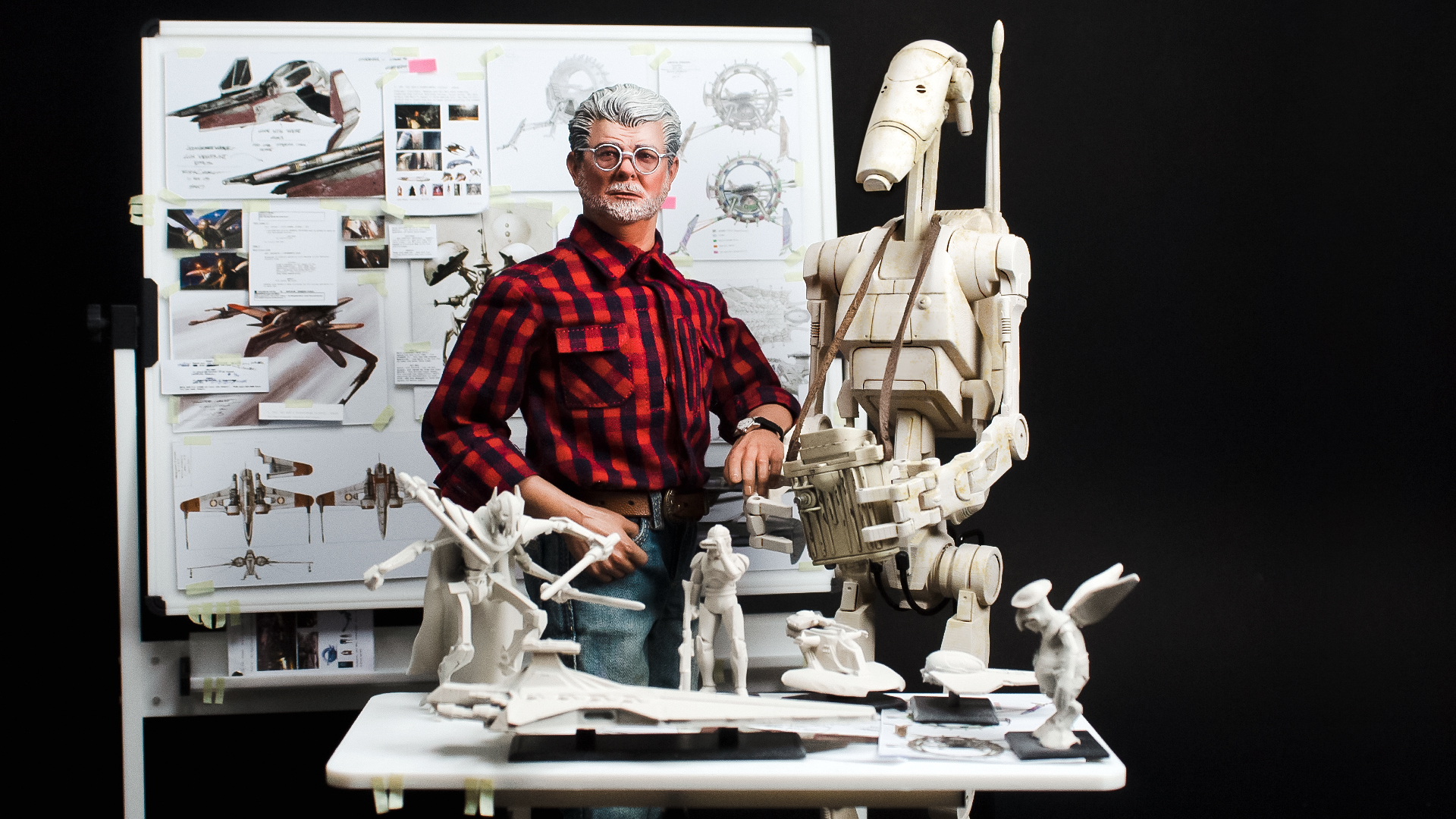
But George Lucas in the place where Star Wars was truly born his creative workspace, where imagination became one of the greatest cinematic universes ever created.
Over the years, we have dedicated countless projects to some of the most iconic characters from the Star Wars universe.
Each creation gave us the opportunity to study costumes, armor, accessories, and environments in extraordinary detail, always striving for the highest level of screen accuracy and craftsmanship.
Eventually, however, we found ourselves asking a simple question:
Who is the true protagonist behind all these stories?
The answer had been in front of us all along.
George Lucas.
The visionary who transformed a handful of notes and an extraordinary imagination into one of the most influential film franchises in history.
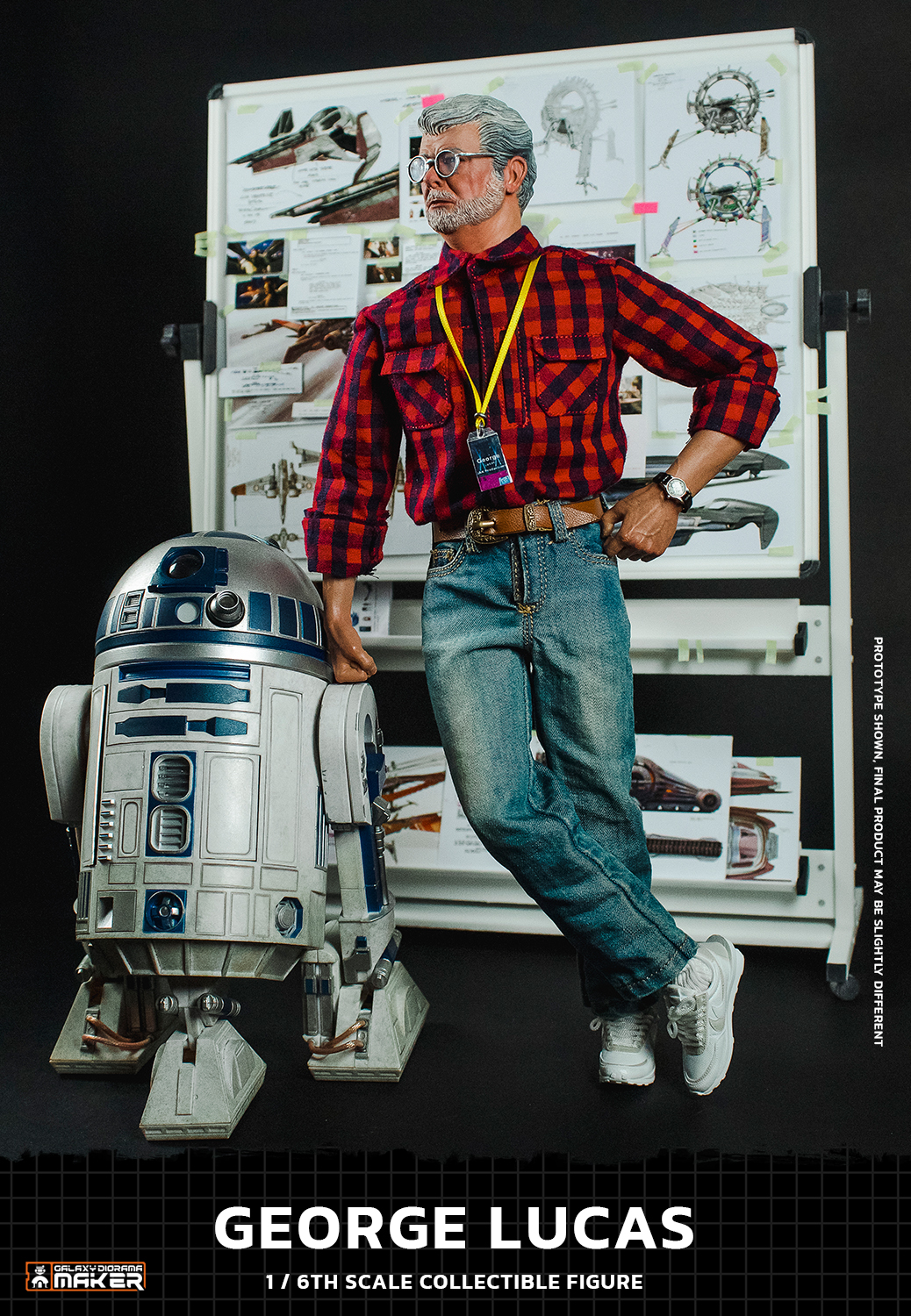
That realization inspired us to create something unlike anything we had ever attempted before: a 1:6 scale tribute to George Lucas himself.
Our goal was to shift the focus away from the fictional universe and celebrate the man whose creativity brought it to life.
It was a completely different challenge from any project we had previously undertaken.
When recreating characters such as Darth Vader or a Clone Trooper, there is an abundance of costumes, props, production references, and official photography to guide every detail.
With George Lucas, everything changes.
You are no longer recreating a fictional character.
You are portraying a real person.
And more importantly, you must capture not only his physical likeness, but also the personality, creativity, and quiet determination that changed the history of cinema forever.
Ogni nostro progetto inizia con una fase di ricerca.
Every project we create begins with a research phase.
This time, however, the process was far more complex than expected.
George Lucas is arguably one of the most photographed figures in cinema history over the past fifty years.
Thousands of images capture him during completely different moments of his life.
With long hair or short hair.
With a beard.
Without a beard.
On film sets.
Inside Lucasfilm offices.
During interviews.
At press conferences.
At the Academy Awards.
The challenge was avoiding the creation of a generic portrait.
Instead, we wanted to capture a very specific moment in his career.
The era of the Star Wars prequel trilogy.
The years when Lucas spent countless hours between the Lucasfilm and Industrial Light & Magic studios, overseeing concept art, models, storyboards, and endless revisions that would eventually bring The Phantom Menace, Attack of the Clones, and Revenge of the Sith to life.
To recreate that atmosphere, we collected hundreds of photographs and hours of behind-the-scenes footage.
Among the most valuable sources were the many documentaries dedicated to the making of the prequel trilogy, filled with rare images filmed inside Lucasfilm studios.
However, the reference that influenced the project more than any other was Light & Magic, the documentary series exploring the creation and evolution of Industrial Light & Magic.
While watching that footage, we were fascinated not only by the visual effects, but by the creative environments where those ideas were born.
Walls completely covered with concept art.
Desks filled with sketches.
Models.
Papers scattered everywhere.
Artists discussing ideas in front of a whiteboard.
George Lucas walking in, observing, suggesting changes, and moving forward.
That was the world we wanted to capture.
Because Star Wars does not begin in front of a camera.
It begins much earlier.
It begins on a sheet of paper.
Once the artistic direction was defined, we entered the most delicate phase of the entire project.
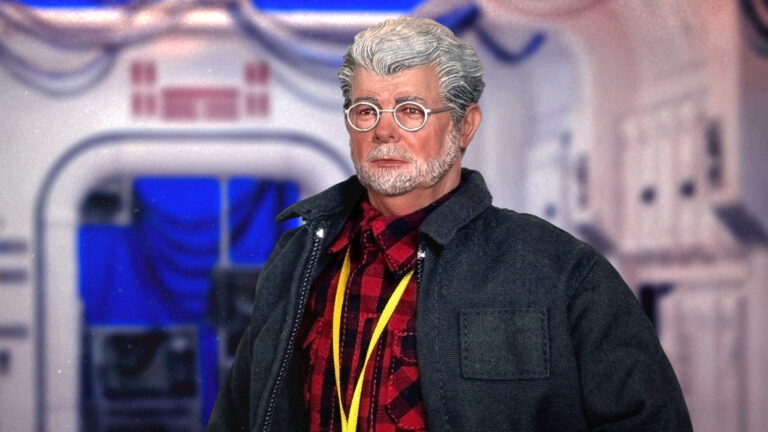
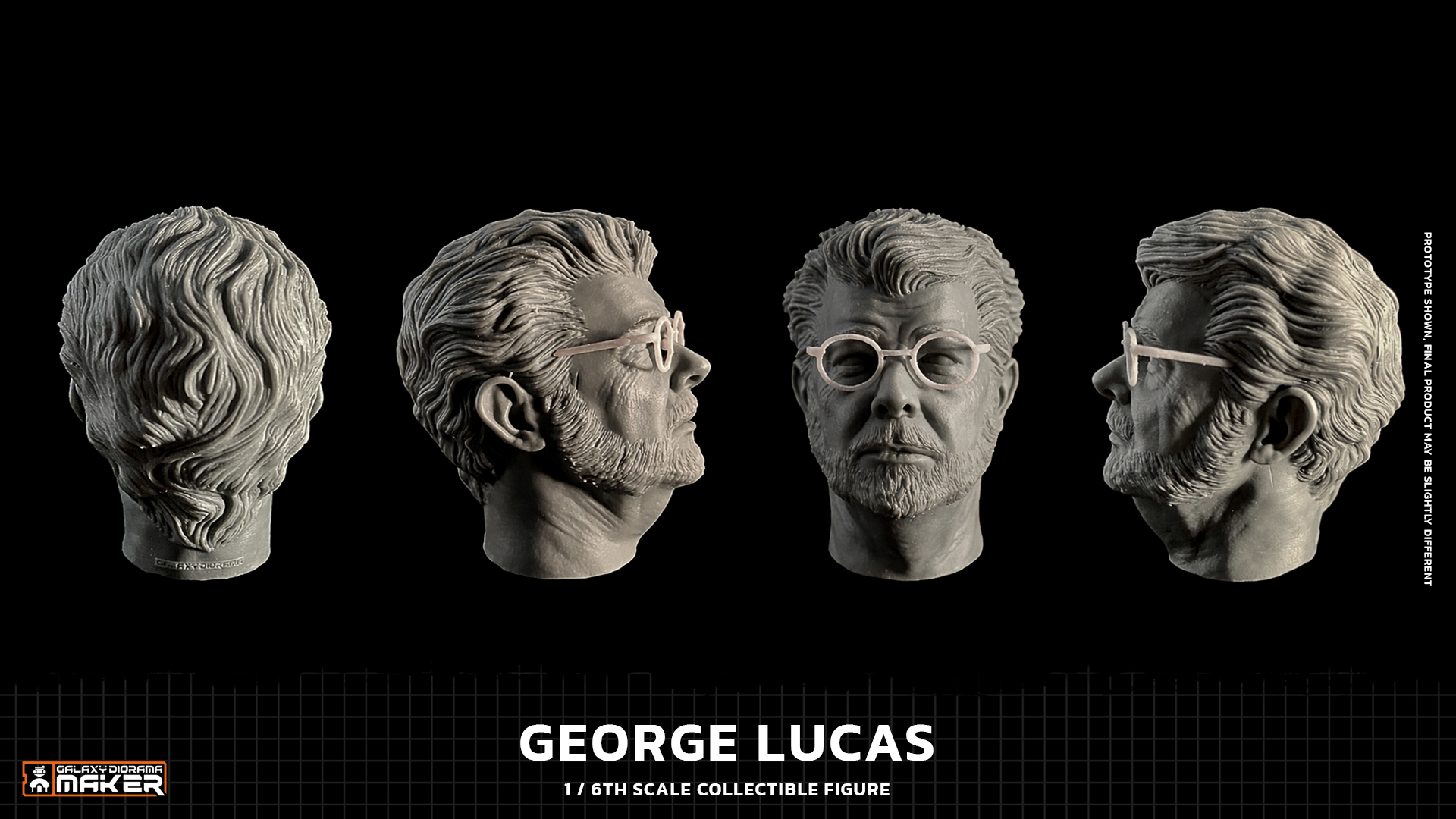
Creating the face.
Sculpting a real person is completely different from recreating a fictional movie character.
Every collector immediately recognizes George Lucas’ face.
A small mistake in facial proportions, the eyes, or the expression can compromise the entire result.
For this reason, the portrait went through countless revisions.
We refined the shape of the eyes.
The structure of the nose.
The cheeks.
The wrinkles.
The beard.
The hairline.
Every adjustment was carefully compared with dozens of photographs from the same period of his career.
The goal was not to create a perfectly symmetrical face.
Quite the opposite.
Small imperfections and natural asymmetries are what make a person truly recognizable.
The real challenge was finding the perfect balance between anatomical accuracy and emotional expression.
We wanted the viewer to recognize George Lucas with a single glance.
But we also wanted that expression to tell a story.
A thoughtful man.
A curious mind.
Someone constantly lost in his own ideas.
Always focused on creating the next world.
Once the sculpture was completed, a second equally delicate phase began.
The painting process.
Each head was entirely hand-painted, using extremely thin layers of color to recreate skin depth, natural tones, and realistic facial details.
The subtle color variations in the beard.
The shadows beneath the eyes.
The nuances of the skin.
The wrinkles.
Every element was carefully studied to avoid an artificial appearance.
The goal was not to create a perfect face.
It was to create a living one.
A face capable of telling the story of time passing and a lifetime spent imagining new worlds.
The painting process was entrusted to Sara Bodei, whose contribution was essential in transforming the sculpture into a believable portrait filled with character and personality.
George Lucas has never been a filmmaker focused on appearances.
While Hollywood celebrated style and glamour, he always preferred clothing that was simple, practical, and functional.
A shirt.
A jacket.
Jeans.
Sneakers.
A look that has become an essential part of his identity.
For this reason, we chose to recreate the outfit most closely associated with him during the production years of the Star Wars prequel trilogy.
Every piece of clothing was specially created for this figure, respecting the proportions of the 1:6 scale and faithfully reproducing the fabrics, stitching, and overall fit.
The simplicity of the outfit perfectly reflects the personality of its owner.
Because the true protagonist was never the way George Lucas dressed.
The true protagonist has always been his ideas.
From the very first stages of the project, we established one important rule.
Every accessory had to tell a story.
No element was included simply to fill the display.
The Star Wars: Episode III – Revenge of the Sith clapperboard, the Fox Studios Australia production badge, the GOSH coffee cup, the glasses, the script pages, the storyboards, and the concept art are not just miniature objects.
They are fragments of a much larger story.
They are details that instantly bring back the years when George Lucas personally oversaw the daily production of the prequel trilogy, working alongside artists, technicians, model makers, and concept designers.
The more the project took shape, the more we realized that this figure was becoming something far beyond a traditional action figure.
It was becoming a portrait of the creative process itself.
And it was at that exact moment that a final idea emerged.
An idea destined to completely transform the project.
Because the true protagonist has always been his ideas.
“It wasn’t another accessory that was missing. It was the place where those ideas came to life.”
When the figure was nearly completed, we had the feeling that the project was not truly finished yet.
The portrait worked.
The outfit was exactly what we had envisioned.
The accessories perfectly captured the George Lucas of the early 2000s.
And yet, every time we looked at the figure on display, we felt that something was still missing.
George Lucas is not a character defined by an heroic pose.
He is not a warrior, a pilot, or a Jedi.
He is a creator.
A man who spent much of his time behind a desk, surrounded by papers, drawings, notes, and ideas.
To truly tell his story, we needed his environment.
Not a simple photographic backdrop.
But a place capable of evoking the moment when a galaxy far, far away was beginning to take shape.
That was when we decided to take on what would unexpectedly become one of the most challenging and exciting parts of the entire project.
Creating a completely new diorama.
Once again, everything began with research.
For weeks, we reviewed documentaries, making-of footage, and behind-the-scenes videos dedicated to the production of the Star Wars prequel trilogy.
We were not looking for details about costumes or visual effects.
This time, we were studying the backgrounds.
The walls.
The desks.
The meeting rooms.
The offices.
The workshops.
Every frame became valuable.
Many of the most interesting details appeared in the moments that seemed the least important: a camera following George Lucas as he walks through a hallway, a meeting with concept artists, a model maker working at a studio table.
These are images that last only a few seconds, yet they reveal an incredible amount.
Once again, a fundamental source of inspiration was Light & Magic, the extraordinary documentary series dedicated to the history of Industrial Light & Magic.
The more we studied those images, the more a common element emerged.
Those spaces did not feel like offices.
They felt like creative laboratories.
Places where dozens of people worked together, constantly sharing ideas, modifying drawings, moving artwork, building models, and bringing new concepts to life.
That was exactly the atmosphere we wanted to recreate.
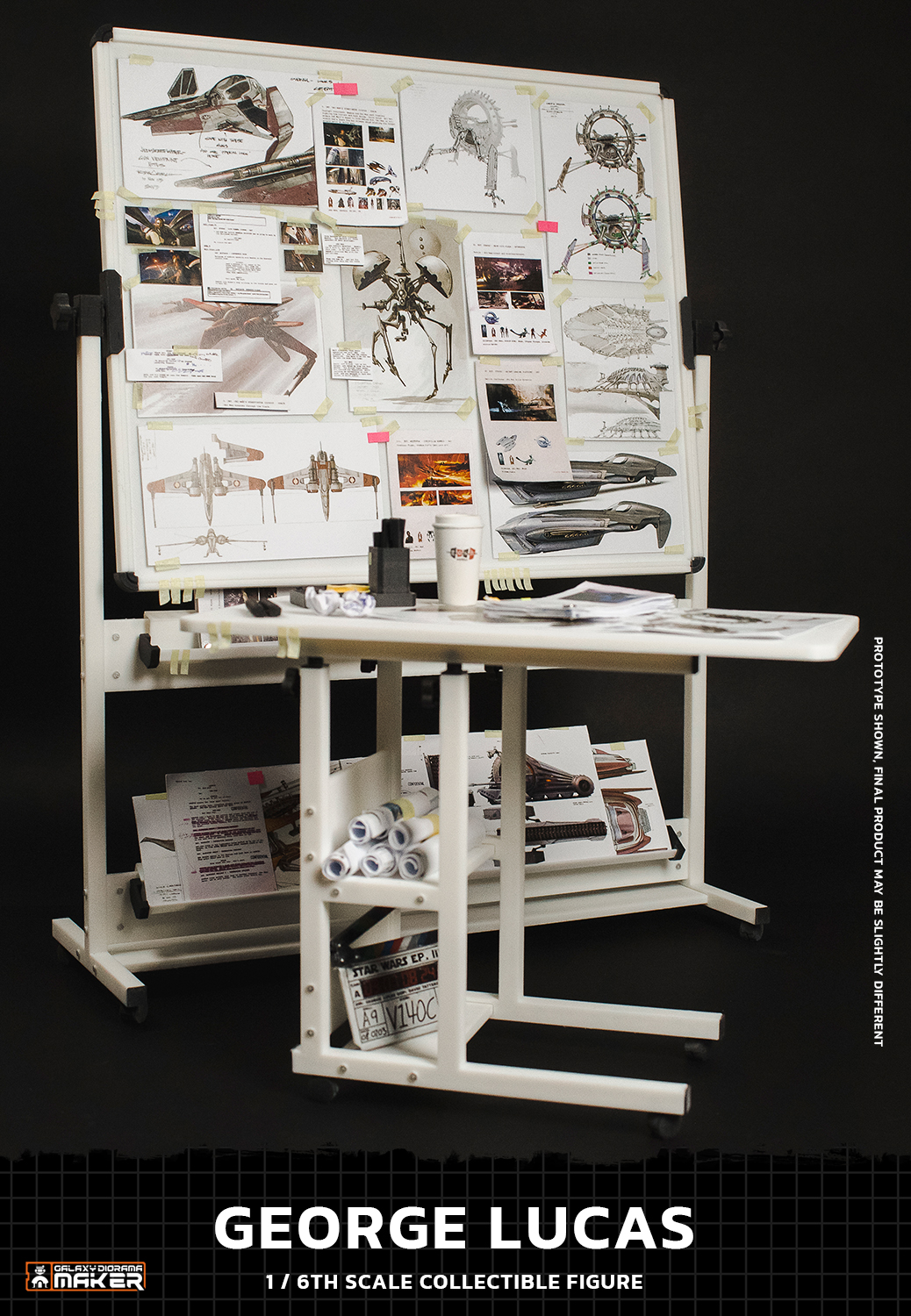
The first element of the diorama was the desk.
We did not want to create an elegant or purely decorative piece of furniture.
We wanted it to feel genuinely used.
For this reason, we filled it with small details that may seem insignificant at first, but are essential for telling a story.
Folders with colored tabs.
Markers.
Printouts.
Loose sheets of paper.
Rolls of drawings.
Notes.
Documents.
Script pages.
Storyboards.
The iconic coffee cup.
Every object suggests that George Lucas simply stepped away for a few minutes, leaving his work exactly where he had left it.
The viewer almost feels that he could return at any moment to continue an interrupted meeting.
We did not want to represent a perfectly organized studio.
Anyone who has worked in a design studio, creative department, or production environment knows that unique balance between order and disorder.
That apparent chaos where every piece of paper has a purpose.
That was exactly the feeling we wanted to capture.
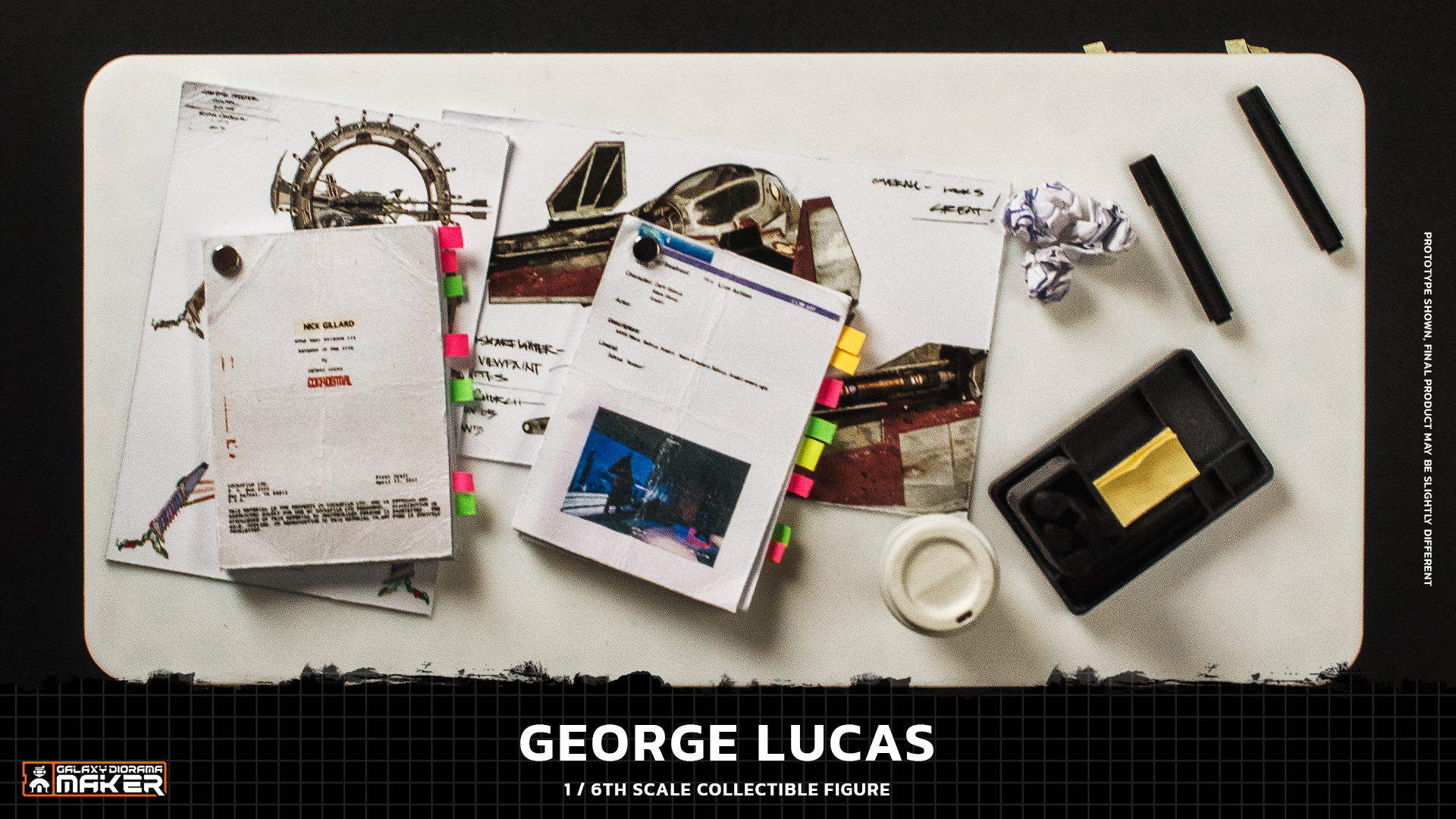
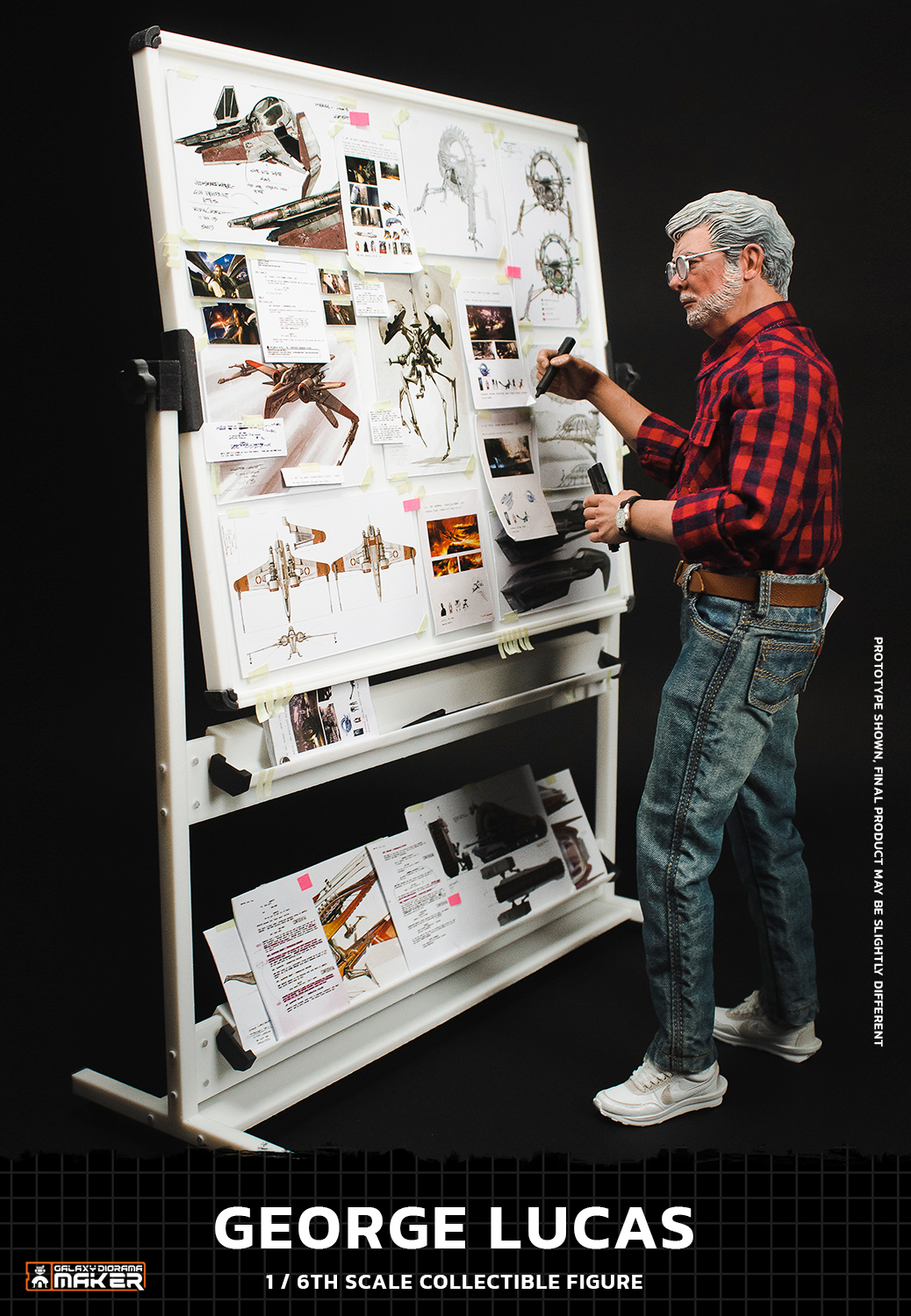
If the desk represents the daily work routine, the large whiteboard represents the moment when ideas are shared and developed.
Once again, we took direct inspiration from the documentaries about the making of the Star Wars prequel trilogy and the behind-the-scenes footage featured in Light & Magic.
The walls of the Lucasfilm studios were covered with concept art.
They were not display panels.
They were working tools.
Images were constantly added, moved, replaced, and annotated during meetings with George Lucas and the creative teams.
We decided to recreate that exact atmosphere.
For this reason, the concept artworks are not arranged in a perfectly symmetrical way.
They are attached with simple paper tape.
Some sheets overlap.
Others are slightly tilted.
Others appear to have been recently moved after a creative discussion.
It is a small detail.
But it is precisely that detail that transforms a wall into a truly lived-in creative environment.
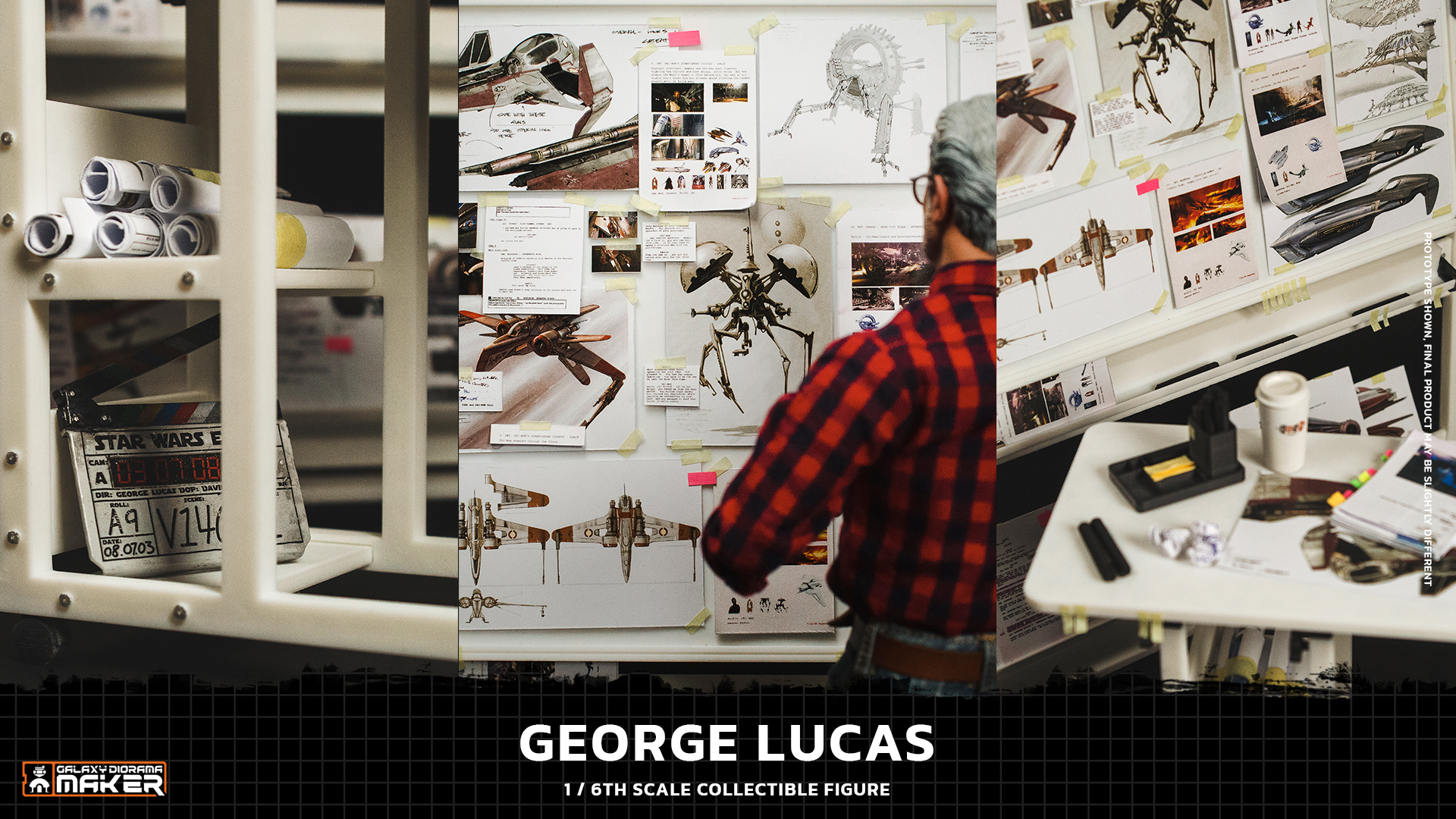
The selection of the images displayed was not accidental.
Many of the concept artworks featured on the board come from the visual development of Star Wars: Episode III – Revenge of the Sith and were created by Ryan Church, the film’s Concept Design Supervisor.
Church was one of the artists who played a major role in defining the visual identity of the Star Wars prequel trilogy.
Among the artworks reproduced in the diorama, you can recognize studies for the ARC-170 Starfighter, concepts for new vehicles, futuristic architecture, droids, and the spectacular volcanic environments of Mustafar.
These images perfectly capture the moment when an idea stops being a simple sketch and slowly begins to transform into cinema.
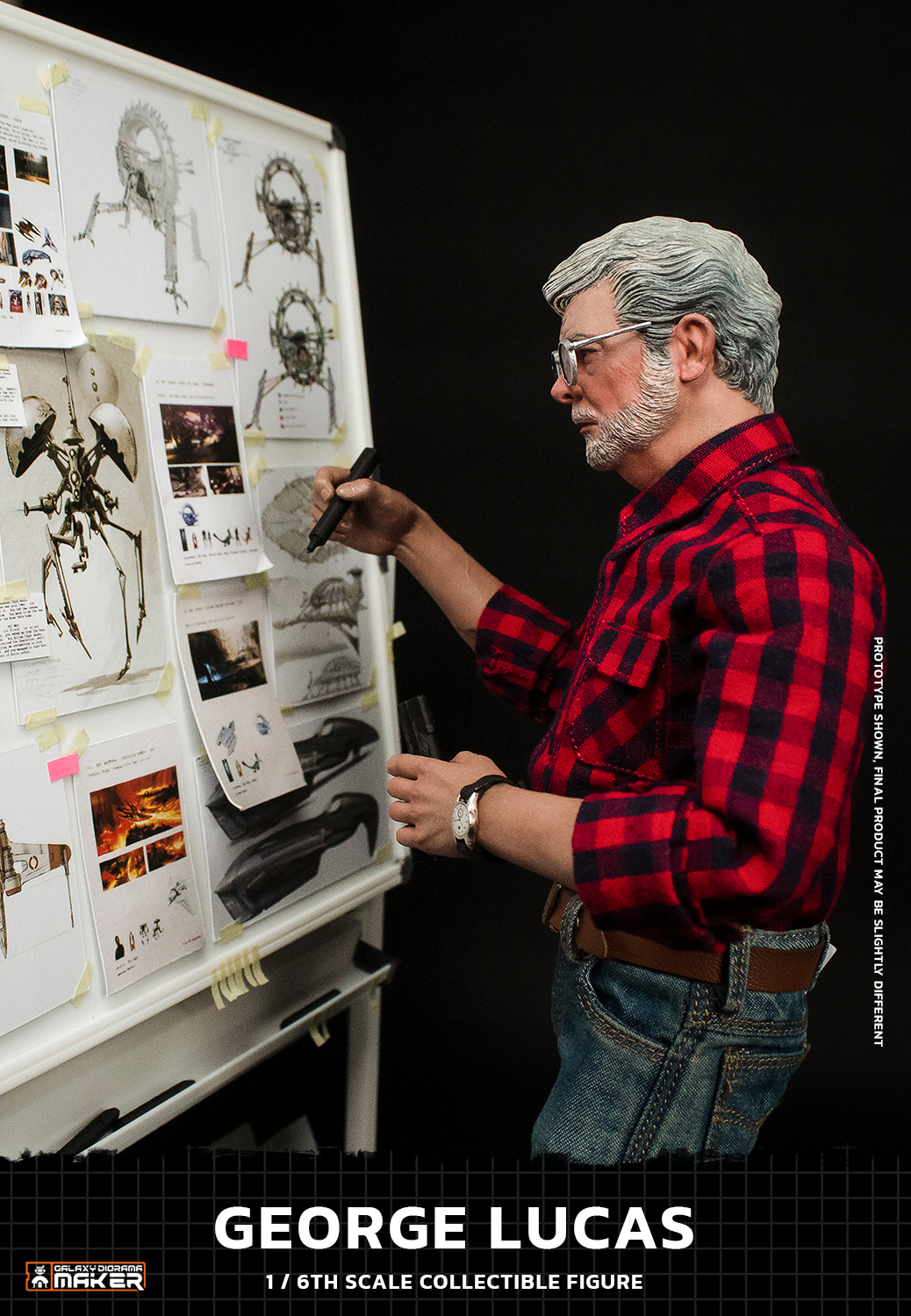
During our research, we repeatedly came across a now-iconic photograph.
George Lucas is inside the model-making department of Lucasfilm and Industrial Light & Magic.
Around him are models, maquettes, prototypes, and miniatures used during the development of the films.
That image perfectly captures the working method adopted during the production years of the Star Wars prequel trilogy.
Before a starship was ever created through computer graphics, it often began as a drawing.
Then it became a model.
After that, it was modified.
Refined.
Redesigned.
Only at the end did it reach the big screen.
We wanted to pay tribute to that exact creative process.
For this reason, our diorama includes a small model-making area inspired by those images.
Among the most significant elements is a B1 Battle Droid, one of the symbols of the Confederacy of Independent Systems and one of the most recognizable designs from the prequel trilogy.
The droid was created and designed by Doug Chiang, Art Director and one of Lucasfilm’s most influential concept designers, whose contribution completely reshaped the visual language of Star Wars throughout Episodes I, II, and III.
Alongside the Battle Droid, we also created several scaled models of starships from the prequel trilogy.
Small miniatures that reference the work of the model makers and designers who transformed simple sketches into three-dimensional creations.
Among them are also two instantly recognizable characters from the saga.
Commander Clone Cody, the loyal Republic officer featured in some of the most memorable sequences of Revenge of the Sith.
And Watto, the Mos Espa merchant who appears in The Phantom Menace and represents one of Anakin Skywalker’s first encounters with his destiny.
These models were not included as simple decoration.
They are small reminders of the long creative process behind every Lucasfilm production.
Each model tells the story of a different stage in the development of a film.
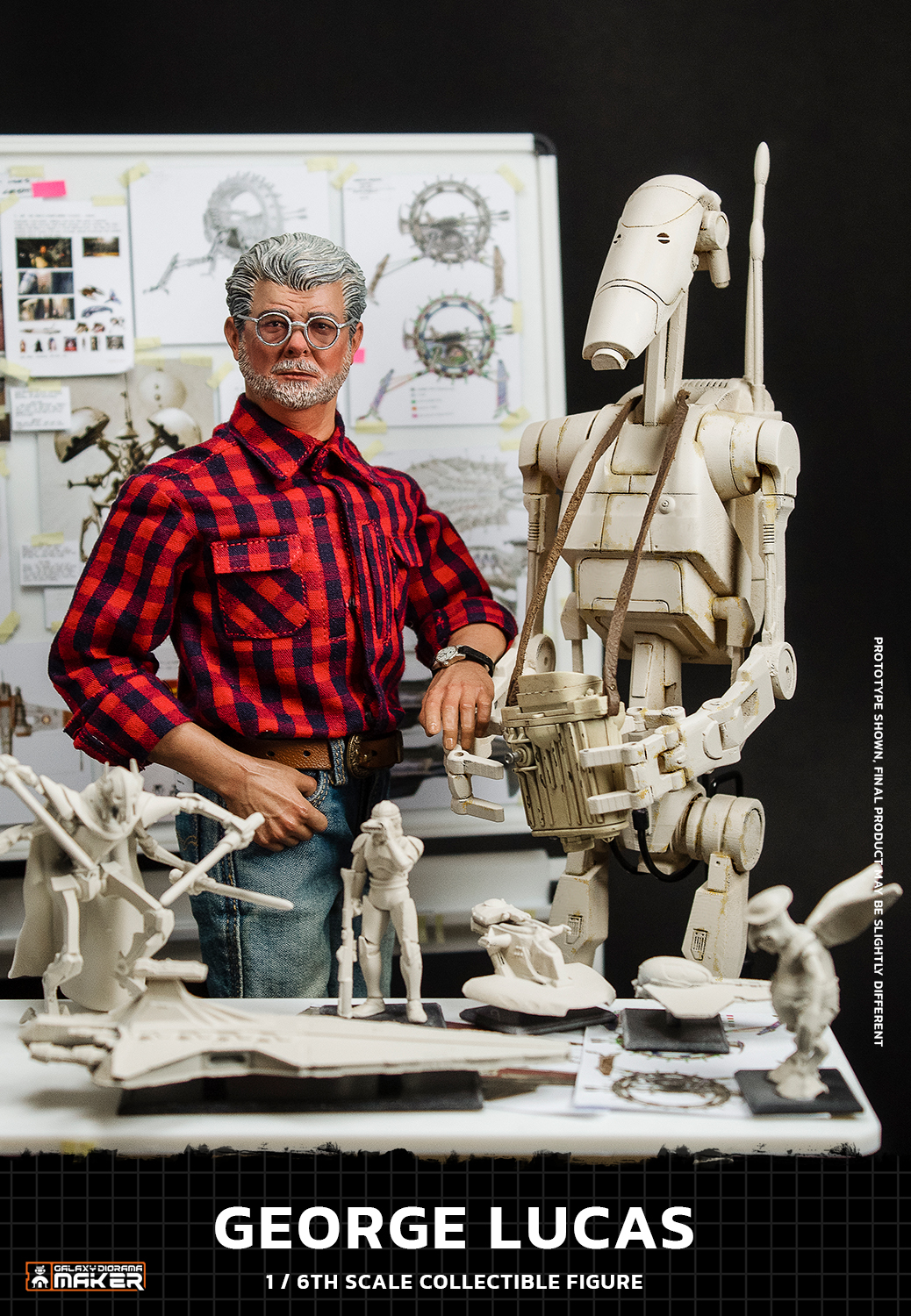
One of the most fascinating discoveries during our research was rediscovering how central traditional model making remained throughout the production of the prequel trilogy.
Although those years marked the beginning of the computer graphics revolution, hands-on craftsmanship continued to play a fundamental role.
Concept artists.
Illustrators.
Sculptors.
Model makers.
Industrial designers.
Every department worked closely with George Lucas on a daily basis.
Ideas constantly moved from paper to physical models, and from physical models to digital creations.
It was a collaborative process.
And that is exactly what we wanted to capture.
Our diorama does not simply represent an office.
It represents the place where dozens of talented professionals transformed ideas and sketches into starships, creatures, planets, and characters destined to become part of cinematic history.
Choosing the 1:6 scale allowed us to refine every detail with the highest level of precision.
The printed materials are readable.
The masking tape maintains realistic proportions.
The small objects on the desk appear genuinely used.
Even when looking closely at the photographs, it becomes difficult to tell where the miniature craftsmanship ends and reality begins.
And perhaps this is the achievement we are most proud of.
Because our goal was not to create a simple backdrop for photographing a figure.
We wanted to build a small fragment of Lucasfilm.
A space capable of telling the story that audiences normally never see.
The place where ideas took shape.
Where George Lucas discussed concepts with Ryan Church, Doug Chiang, and the artists of Lucasfilm and Industrial Light & Magic.
Where every concept was reviewed dozens of times.
Where a simple pencil sketch could change the destiny of an entire scene.
Ultimately, this diorama represents the true essence of the entire project.
It does not celebrate Star Wars as a film.
It celebrates the work, research, imagination, and creative collaboration that made Star Wars possible.
And it was only by looking at the final result that we realized something.
Our George Lucas figure was no longer just a figure.
It had become a portrait of a unique and unrepeatable moment in cinematic history.
After months of research, design, prototyping, and continuous refinement, the most exciting moment finally arrived: seeing all the elements brought together.
The figure.
The accessories.
The desk.
The whiteboard covered with concept art.
The small model-making department.
Each element, viewed individually, told a part of the story.
Together, however, they told something much greater.
They told the story of George Lucas at work.
Not the Oscar-winning filmmaker.
Not the creator of one of the most famous sagas in cinematic history.
But the man sitting at a desk, discussing a concept, examining a model, or reviewing a storyboard.
It was exactly the image we wanted to create from the very beginning.
Behind this narrative vision, of course, there is also a long and meticulous technical process.
Every element of the figure was developed with the goal of offering collectors the highest possible level of accuracy and versatility.
The fully articulated body features more than 30 points of articulation, allowing collectors to recreate natural poses inspired by the many photographs of George Lucas on set and inside Lucasfilm studios.
To further expand display possibilities, we created three different sets of interchangeable arms, designed to represent various moments of the creative process:
The portrait was also created with the goal of achieving maximum realism.
The head sculpt faithfully reproduces George Lucas’ likeness, with particular attention to his expression, wrinkles, beard, and subtle skin variations. Each piece is entirely hand-painted, making every figure slightly different and truly unique.
The outfit perfectly captures the image we all remember of the filmmaker during the years of the Star Wars prequel trilogy.
The costume includes:
A deliberately simple choice.
George Lucas never built his legacy through appearance.
His true strength has always been his ability to imagine new worlds.
Even his clothing reflects that same sense of simplicity.
Ogni accessorio incluso nella confezione è stato scelto per evocare un preciso momento del lavoro di George Among the included elements are:
More than simple accessories, these are working tools.
Everyday objects that transform the figure into a small scene of real life.
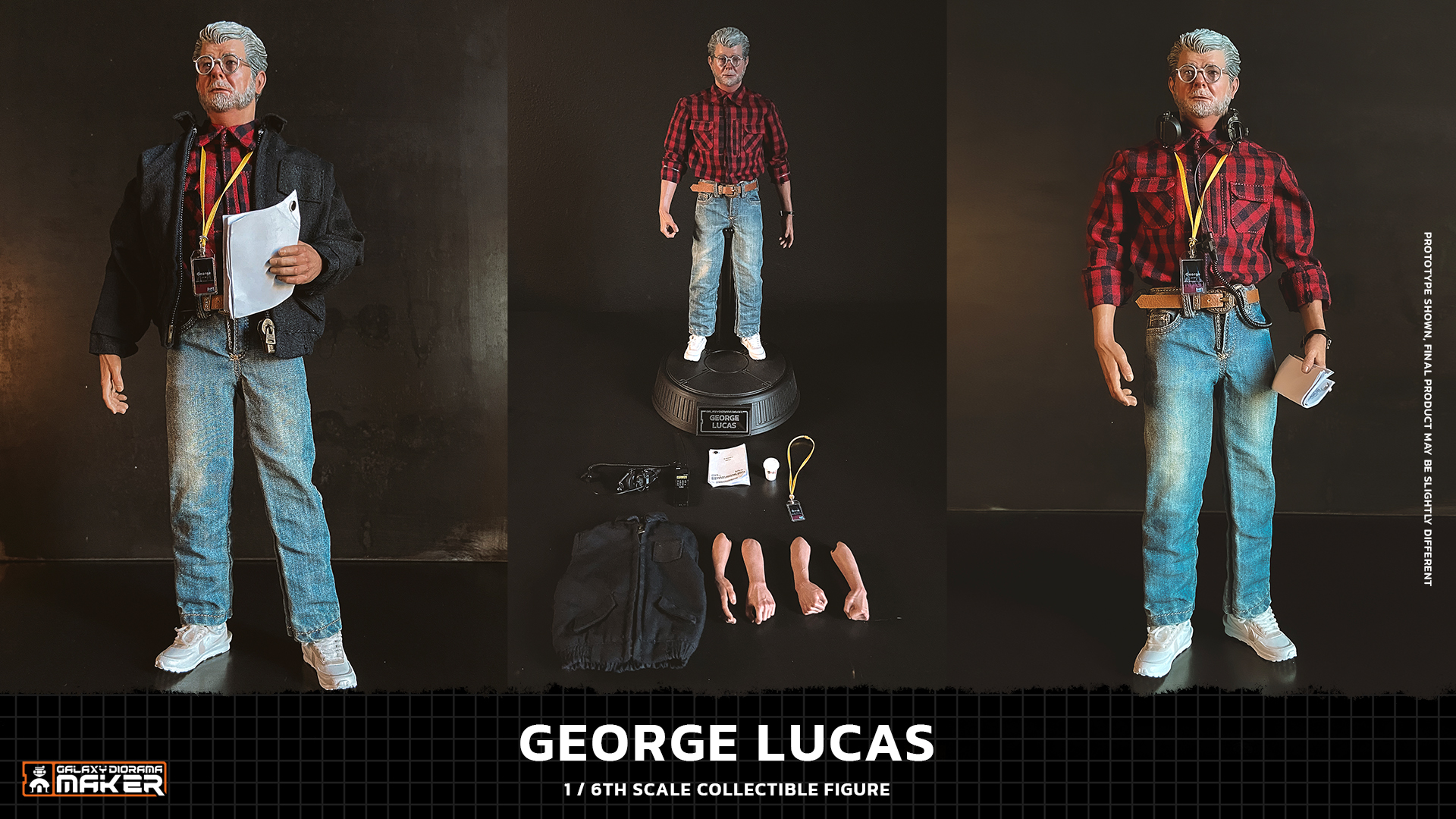
Product: George Lucas
Scale: 1:6
Height: Approximately 30 cm
Manufacturer: Galaxy Diorama
Limited Edition: 5 pieces
Shipping Period: April – May 2026
Stefano Mondini – Art Direction
Marco Mangiarotti – Technical Support
Sara Bodei – Head Painting
The decision to limit this figure to only five pieces was not driven by the desire to create exclusivity at all costs.
Instead, it was born from a production necessity.
Each piece requires weeks of craftsmanship.
Every head is individually hand-painted.
Every accessory is carefully inspected one by one.
Each element is assembled and quality-checked individually.
Limiting the number of editions allows us to dedicate the time and attention that a project of this level truly deserves to every single piece.
It is a completely different approach from industrial production.
Slower.
More complex.
But also far more personal.
If there is one aspect that truly surprised us throughout these months, it has been the incredible response from our community.
We chose to share the project from its very earliest stages.
We revealed preliminary studies, work-in-progress photographs, sculpture updates, painting tests, accessories, and diorama details.
Our goal was to involve collectors in the creative journey.
What we did not expect was the level of enthusiasm it would generate.
Every new update sparked conversations, comments, suggestions, and messages from passionate collectors around the world.
Many of you followed the entire project from beginning to end, experiencing every stage of its evolution alongside us.
For us, this continuous dialogue was just as important as the project itself.
One of the most frequent requests we received was the possibility of reopening pre-orders.
Several collectors who were unable to purchase the figure during the first pre-order window contacted us asking for a second opportunity.
At this time, we are seriously considering this possibility.
The idea would be a potential pre-order reopening in September.
However, there is currently no official confirmation.
If we decide to move forward, all information will be announced through our website and social media channels.
The enthusiasm shown by the community has been one of the greatest recognitions this project could have received.
There is one aspect that makes the conclusion of this work even more meaningful.
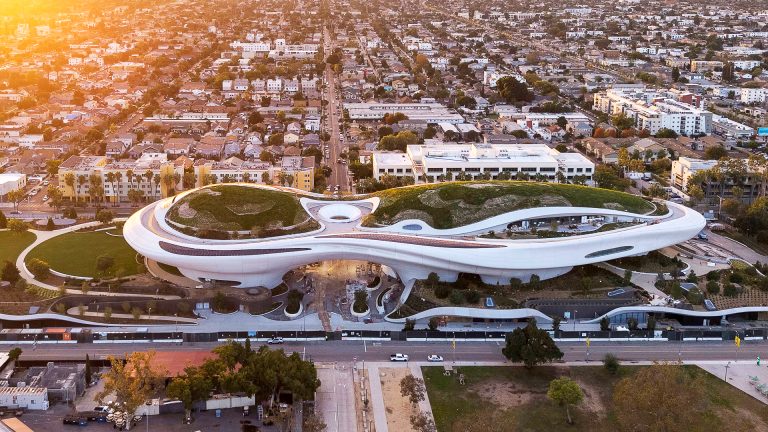
While we were completing this tribute dedicated to George Lucas, the world of cinema was preparing for the opening of the Lucas Museum of Narrative Art in Los Angeles.
A project envisioned by George Lucas over decades and destined to become one of the most important museums dedicated to the art of visual storytelling.
It will not be a museum dedicated only to Star Wars.
It will be a place where illustration, comics, cinema, painting, photography, and concept art come together to celebrate the universal power of images.
And this is exactly where our project finds its connection.
In our own small way, we also wanted to tell not only the story of a man, but the value of the creative process itself.
The concept art displayed on the whiteboard.
The starship models.
The Battle Droid designed by Doug Chiang.
The artwork by Ryan Church.
The desk covered with sketches.
The half-finished coffee.
The scattered documents.
Every element is meant to remind us that before every film, there is an idea.
Before every scene, there is a drawing.
Before every character, there is a pencil.
And it was precisely inside those studios of Lucasfilm and Industrial Light & Magic that, day after day, those ideas took shape.
Looking at this completed project today, we realize that defining it simply as an action figure would be an understatement.
We did not want to represent a character.
We wanted to represent a moment.
The moment when George Lucas imagined worlds that did not yet exist.
The moment when a meeting in front of a whiteboard could become a new starship.
A planet.
A droid.
A scene destined to become part of cinematic history.
Perhaps this is exactly why the project required so much time.
Because we were not only searching for a physical likeness.
We were trying to tell a creative philosophy.
To show the place where imagination became reality.
If, by looking at this figure, someone can imagine—even for a single moment—George Lucas discussing ideas with Doug Chiang, Ryan Church, or the artists of Industrial Light & Magic in front of a wall covered with concept art, then we will have achieved our goal.
Because great stories do not begin in front of a camera.
They begin much earlier.
They begin in front of a blank sheet of paper.
And that is where we chose to stop time.