
There are some news stories that are difficult to write.
This is one of them.
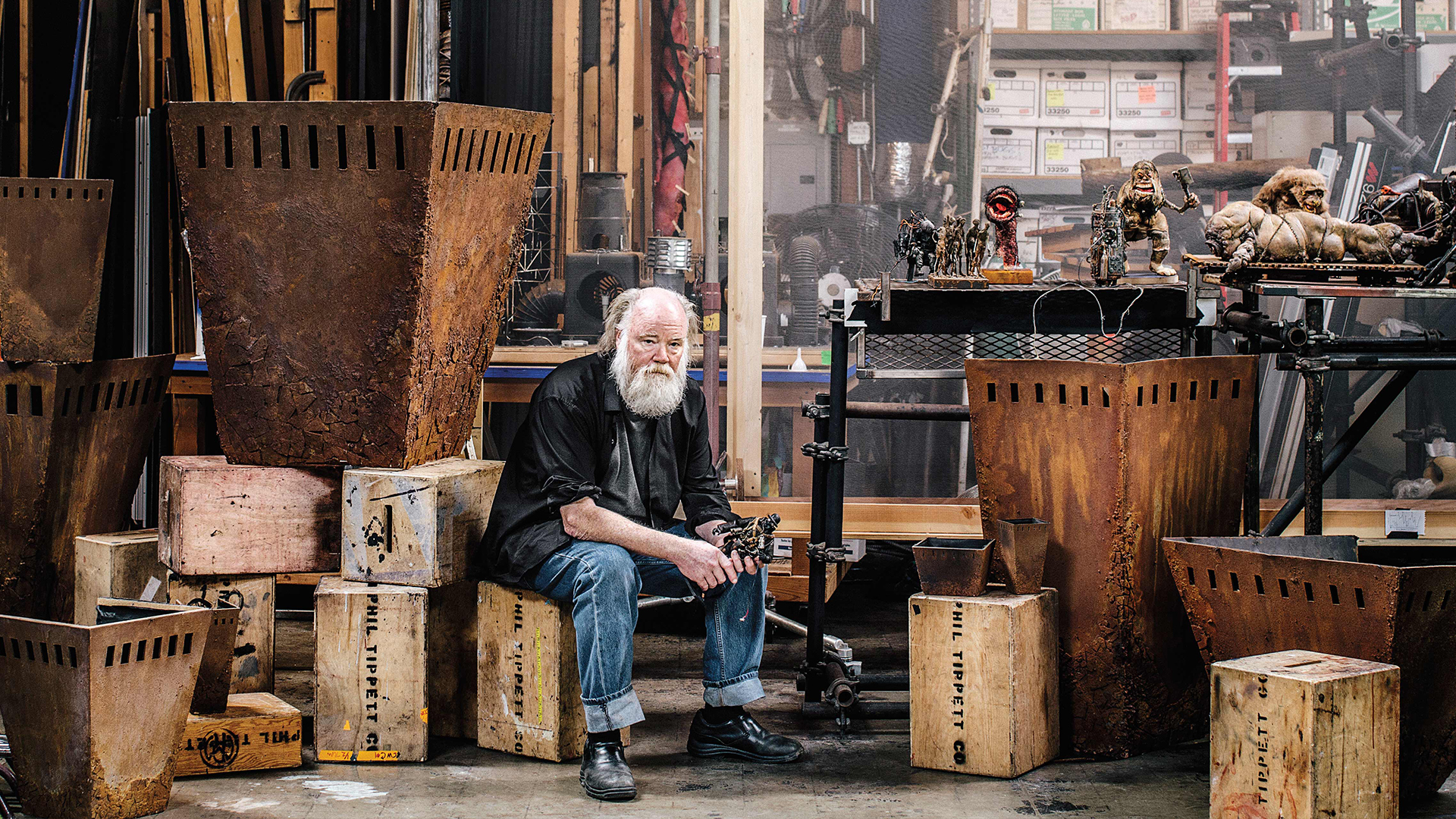
When we heard that Tippett Studio in Berkeley is closing its doors for good, and that the historic studio is now being cleared out, with decades of models, creatures, props, concept art and memorabilia being sold, our first reaction was simply sadness.
A very difficult kind of sadness to explain.
Because to us, Tippett Studio was never just a visual effects studio.
It was one of those places that, even if you had never been there, somehow felt familiar.
We discovered it through behind-the-scenes photographs, documentaries, books and, above all, through the incredible models and creatures that helped define the movies we grew up with.
And that is why seeing the studio being emptied today feels so strange.
It feels like watching a piece of our own history disappear.
We never worked at Tippett Studio.
We never walked through the doors of the Berkeley facility.
And yet, through photographs, making-of documentaries and books, it became a place we felt we knew almost as if we had been there.
Shelves filled with models.
Unfinished creatures.
Miniature sets.
Puppets.
Tools.
Drawings.
Pieces of props.
Everything that normally remains invisible when we watch a movie.
That is what has always fascinated us.
Before a creature became an image on a movie screen, someone had actually built it.
Someone sculpted it.
Someone painted it.
Someone created its mechanical parts.
Someone spent hours, days or weeks making it move.
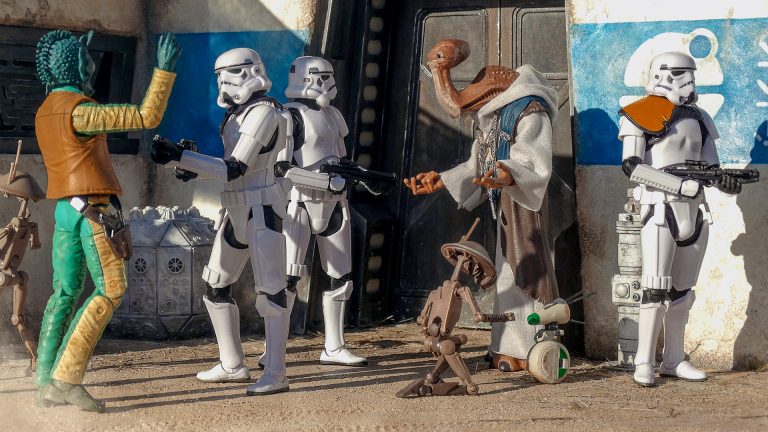
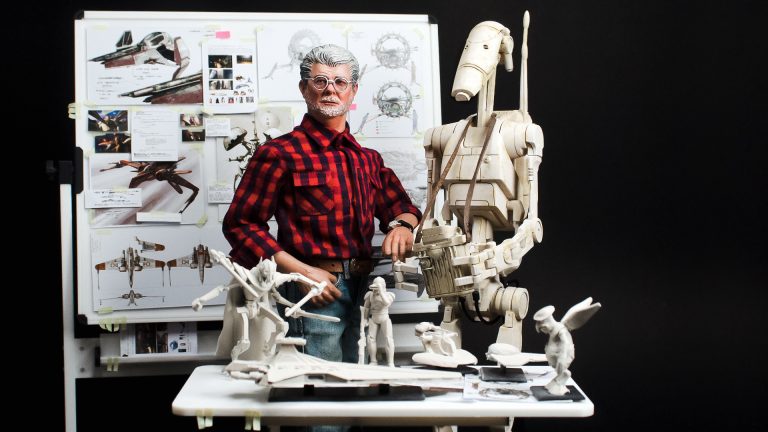
That is the magic we have always looked for in dioramas.
The story of Phil Tippett is, in many ways, a story of modern movie visual effects itself.
His artistic roots go back to Ray Harryhausen and traditional stop-motion animation.
Then came Star Wars.
And ILM.
Tippett worked on the original Star Wars trilogy and contributed to some of the most iconic creatures and effects ever seen on screen.
The AT-AT walkers on Hoth.
The Rancor.
The creatures of the Dejarik game aboard the Millennium Falcon.
And his work did not stop there.
His career also includes films such as RoboCop, Jurassic Park and Starship Troopers, among many others.
Then the digital revolution arrived.
And Phil Tippett adapted.
That is one of the things we admire most about his career.
He moved through completely different eras of visual effects without losing the craftsmanship that had always defined his work.
Tippett was also one of the artists at the center of the transition from physical models to digital visual effects.
His work on go-motion pushed stop-motion animation toward more natural movement.
Then came Jurassic Park.
And CGI changed everything.
The industry was transforming.
Things that had seemed impossible only a few years earlier were suddenly possible on a computer.
But Tippett brought something from the physical world into that new digital era.
A respect for models.
For movement.
For creatures.
For the physical process behind an image.
That is what makes his career so fascinating.
It is not the story of an artist who refused to change.
It is the story of an artist who kept finding new ways to build worlds.
Over the past few days, we have seen several different versions of the Tippett Studio story circulating online.
There is one important point we think is worth clarifying.
The 2026 closure is not simply a case of “PhantomFX bought Tippett Studio and then shut it down.”
The actual timeline is more complicated.
PhantomFX announced an agreement to acquire 80% of Tippett Studio.
At the time, there was no talk of closing the studio.
Quite the opposite.
The plan was presented as an international expansion, with the intention of retaining the Tippett brand, continuing operations in the United States and Canada, and using Phil Tippett’s experience to develop new projects and intellectual property.
Growth was the message.
Not closure.
On May 1, 2024, Tippett Studio Inc. filed for Chapter 11 bankruptcy protection in the U.S. Bankruptcy Court for the Northern District of California.
This distinction is important.
Chapter 11 does not automatically mean that a company closes.
It is a reorganization process that can allow a struggling company to continue operating while restructuring its finances and business.
And that is what happened.
Tippett Studio continued working.
Despite the Chapter 11 filing, the studio remained involved in film and television productions.
Recent work has included projects such as Star Wars: Skeleton Crew and The Mandalorian and Grogu.
So it would be misleading to describe the story simply as:
“PhantomFX bought Tippett Studio and shut it down.”
The reality was much more gradual.
The acquisition of the 80% stake was formally completed on July 1, 2025.
Tippett Studio officially became a subsidiary of PhantomFX.
And even in November 2025, PhantomFX was presenting Tippett as part of its new Phantom Media Group, alongside several other studios.
The public message was still one of international expansion.
Not disappearance.
Then everything changed.
Phil Tippett decided to retire.
And with his retirement came the decision to close the historic Berkeley studio.
This time, permanently.
The part that affects us most is not just the fact that the studio will no longer produce new work.
It is what is happening inside those rooms.
The building is being cleared.
And everything accumulated over decades is being sold.
Creatures.
Miniatures.
Models.
Props.
Concept art.
Equipment.
Memorabilia.
Objects connected to Star Wars, Jurassic Park, Starship Troopers and many other productions.
It is difficult to look at those photographs without feeling something.
Because every object has a story.
Someone built it.
Someone modified it.
Someone painted it.
Someone animated it.
Someone took it onto a set.
And now it is leaving the place where it was created.
It is a question that has inevitably appeared in online discussions.
Was PhantomFX responsible for Tippett Studio’s financial problems?
We cannot say that.
We have not found enough evidence to present that as a fact.
The documented timeline tells a more complicated story.
The Chapter 11 filing came in May 2024, before the acquisition was formally completed in July 2025.
The studio continued working during the restructuring.
The reorganization process continued into 2026.
And eventually, Phil Tippett’s retirement coincided with the closure of the historic Berkeley studio.
We do not want to invent a villain where the available evidence does not allow us to do so.
We would rather focus on what we know.
And on what this story means to us.
Because Galaxy Diorama was inspired by this culture.
It was inspired by ILM.
By Star Wars.
By the behind-the-scenes footage.
By the question:
“How did they build this?”
We have always been fascinated by physical models.
Miniatures.
Sets.
Creatures.
Props.
The details that might appear on screen for only a few seconds, but that someone may have spent weeks building.
That is the part of filmmaking that has always fascinated us the most.
And it is probably one of the reasons we became so passionate about dioramas.
Today we use completely different tools.
3D modeling.
Resin 3D printing.
3D scanning.
Digital sculpting.
Software that allows us to create details that would have seemed impossible decades ago.
But underneath all of that, the basic idea is still the same.
Build something.
Take an idea and turn it into something physical.
Look at it from every angle.
Hold it in your hands.
Try to make it feel real.
That feeling, we believe, is not so different from what must have existed inside the ILM and Tippett workshops decades ago.
The tools change.
The passion doesn’t.
There is another important distinction.
The closure of the historic Berkeley studio does not mean that everything connected to Phil Tippett suddenly disappears.
His professional legacy is much larger than one building.
There have been other locations, collaborations and international activities throughout the years.
But more importantly, there is the work he has left behind.
That cannot be closed.
It cannot be auctioned.
It cannot be removed from a building.
It remains in the movies.
It remains in the models.
It remains in photographs and behind-the-scenes footage.
It remains with collectors.
And it remains in everyone who was inspired by those films to build something of their own.
Perhaps this is the one positive thing we can take from all of this.
The objects leaving Berkeley will not necessarily disappear.
Many will find their way into the hands of collectors and enthusiasts.
Some will be displayed.
Others will become part of private collections.
And we like to think that, in their own way, they will continue telling their stories.
Phil has said that he intends to keep at least his two Academy Awards — the Oscars he received for Return of the Jedi and Jurassic Park.
It makes perfect sense.
But most of the other material has to find a new home.
And perhaps, years from now, someone will see one of those pieces in a collection and think:
“This was made at Tippett Studio.”
And suddenly it will no longer be just a model.
It will be a piece of movie history.
Perhaps the most touching words are Phil Tippett’s own.
Speaking about the closure of his studio during a CBS interview, he looked back on almost four decades with remarkable simplicity:
“We had almost a 40-year run. It was a good run.”
Almost forty years.
It sounds simple when you say it like that.
But inside those words are a lifetime, an extraordinary career and an incredible amount of movie history.
And yet, Phil does not sound quite ready to stop being Phil Tippett.
When asked about retirement, his answer was characteristically direct:
“I will die with my sword in my hand.”
We love that sentence.
Because it somehow says everything.
A studio can close.
A building can be emptied.
A career can enter a new chapter.
But it is difficult to imagine Phil Tippett simply stopping.
That urge to build, experiment, invent and bring impossible things to life does not seem like something you can simply retire from.
And maybe that is the best way to say goodbye.
Not by thinking about the end.
But by thinking about everything he managed to build during those almost forty years.
“It was a good run.”
Yes, Phil.
It really was.
We never worked at Tippett Studio.
We never walked through those rooms.
But somehow, that place became part of our story.
It came into our lives through Star Wars.
Through ILM.
Through behind-the-scenes documentaries.
Through models.
Through the desire to understand how those impossible images were actually created.
And, indirectly, it became part of Galaxy Diorama.
That is why we do not simply want to write about the closure of a visual effects studio.
We want to say thank you.
Thank you, Phil.
Thank you for the creatures.
Thank you for the models.
Thank you for the stop-motion.
Thank you for go-motion.
Thank you for helping transform Star Wars into something that still moves us decades later.
Thank you for showing that a model built by hand can become a character, a creature, a vehicle or an entire world.
And most of all, thank you for the inspiration.
Because perhaps Tippett Studio in Berkeley will close.
Its rooms will be emptied.
Its models will go to different homes.
But that passion will not disappear.
It will continue every time someone builds a model on a workbench.
Every time someone recreates a Star Wars scene.
Every time a collector looks at an old movie prop and wonders how it was made.
And it will continue here, at Galaxy Diorama.
In our own small way.
With our own tools.
With our own dioramas.
With the same sense of wonder that made us fall in love with this world in the first place.
Goodbye, Tippett Studio.
Thank you for the inspiration.
May the Force be with you, Phil.