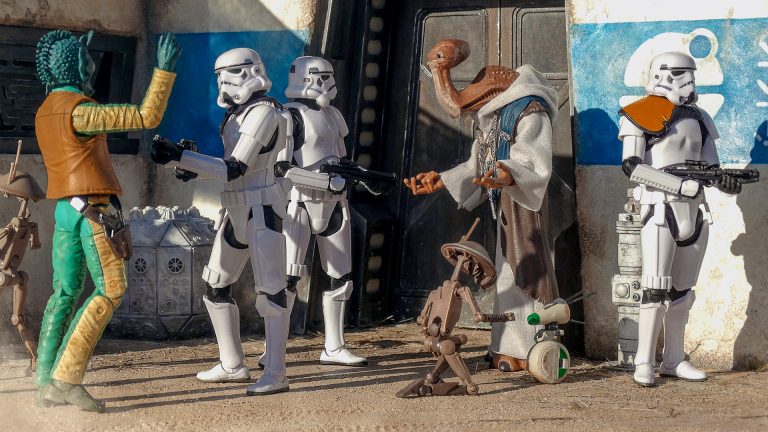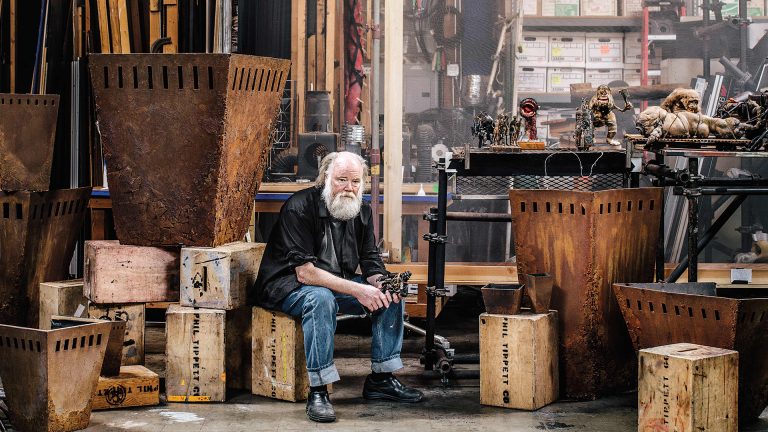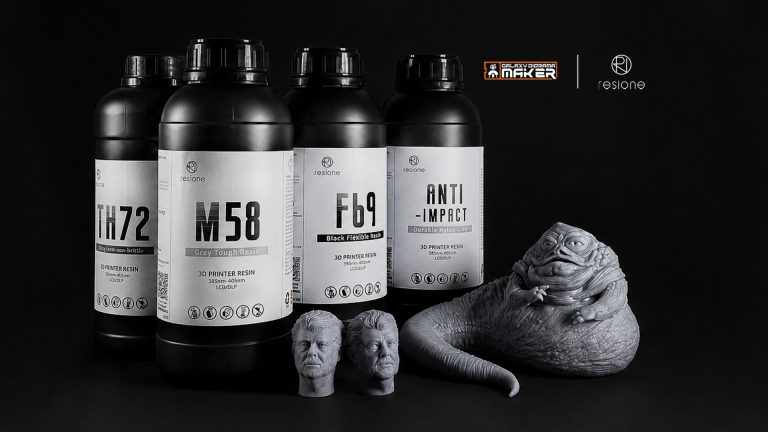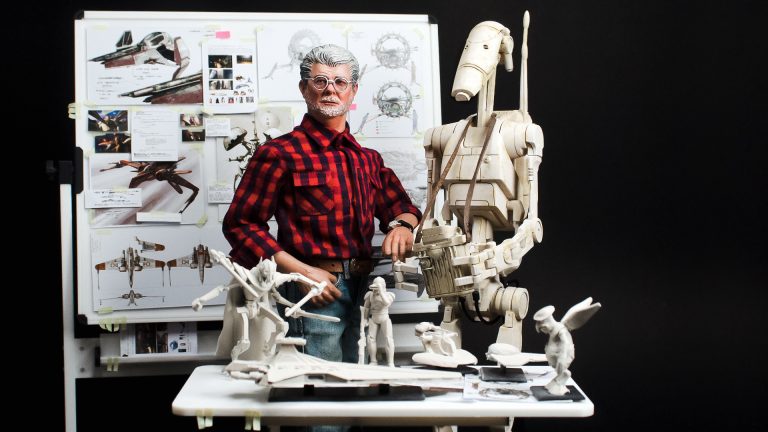


I have many heroes in my mind, and among them are certainly the artists and creatives who brought the Star Wars films to life.
Not Jedi or space smugglers, but real people—often invisible—who gave physical form to an imaginary universe that is still alive today.
We talked about this idea in our article “Star Wars dioramas, necessary failures, and the strength to never give up”, because the history of Star Wars is not only a cinematic saga. It is an ongoing lesson in creative resilience, necessary failures, and solutions found with hands covered in glue.
Among all these silent heroes, one stands as an absolute reference for us: Lorne Peterson.
Lorne Peterson did not begin his career as a “visual effects technician.”
He trained as an artist and designer, earning a degree in Art from California State University, Long Beach. This detail is crucial: before techniques and tools, Peterson brought with him a visual sensitivity—an ability to observe shapes, volumes, and materials as narrative elements.
When George Lucas hired him in 1975, Peterson was twenty-nine years old and expected to stay for just two months. No one, least of all him, imagined that this would become a thirty-three-year career, six Star Wars films, an Academy Award, and a legacy that continues to inspire generations of model makers and diorama artists.
Talking about ILM in the 1970s means describing something very different from the industry we know today.
Lorne Peterson often described those early months in Van Nuys as similar to a university art department—but with more money and far more urgency.
There were no structured pipelines. No manuals.
Cameras, motion-control rigs, tools, and even the computers needed for visual effects were built in-house. Before creating images, the team had to invent the way to create them.
This is where the true soul of Star Wars model making was born: constant experimentation, total collaboration, and deep trust in individual talent.
George Lucas had invested much of the film’s budget in visual effects, but when he returned from England, very few shots were ready. The pressure was intense.
The issue was not incompetence—it was that ILM was inventing everything from scratch. To prove the project was viable, several key sequences were produced at breakneck speed, including:
close-up details of the Death Star cannon
the escape pod descent carrying R2-D2 and C-3PO
The escape pod model was built by Peterson in just one week. A perfect example of how urgency in Star Wars often generated brilliant solutions.
One of the most emblematic stories about Lorne Peterson’s contribution involves something seemingly trivial: super glue.
At the time, film model shops relied mostly on slow-curing epoxy. Peterson, thanks to his background in industrial design, was familiar with a fast, industrial adhesive that was virtually unknown in film work.
When he demonstrated that a pencil could be suspended in midair with a single drop of glue, it permanently changed the pace of the model shop.
That, too, is why those “two months” never ended.
Lorne Peterson worked as a model maker on all six original Star Wars films and was one of the founding members of Industrial Light & Magic.
Among the most iconic models he contributed to:
the Millennium Falcon, one of his personal favorites
the Executor, the Star Destroyer over three and a half meters long
Slave I, Boba Fett’s ship, designed with Ease Owyeung and Sam Zolltheis
Slave I represents a particularly meaningful moment. During a period of rapid departmental growth, Peterson chose to personally dedicate more time to the project, returning to hands-on model building. The result is one of the most recognizable ships in the entire saga.
Few people know that Lorne Peterson also appears on screen in A New Hope.
At the Rebel base on Yavin 4, he is the man operating a tower—motionless for hours under the Guatemalan sun, suspended by cables, waiting for the light to be just right.
He later described it as a true Indiana Jones–style adventure, involving military flights, jungles, and total improvisation. Once again, Star Wars as a lived experience—not just a constructed one.
After the enormous success of the first film, no one at ILM truly expected Star Wars to become a global phenomenon.
With The Empire Strikes Back, everything changed. ILM moved into a massive warehouse in Northern California, without internal walls, marking departments simply by placing wooden beams on the floor.
The model shop grew from seven people to dozens, then hundreds.
Yet the spirit remained that of a craft workshop, where every problem was solved collectively.
In 1984, Lorne Peterson won the Academy Award and BAFTA for Indiana Jones and the Temple of Doom.
It was an extremely model-intensive film, with massive sets, water, lava, and outdoor constructions built under harsh conditions.
In 1988, he served as chief model maker for Willow, proving that his talent was not tied exclusively to Star Wars, but to a broader vision of fantastical cinema.
His career also includes work on:
E.T.
Jurassic Park
Men in Black
Pirates of the Caribbean
A filmography that mirrors the evolution of visual effects from the 1970s into the digital era.
Peterson witnessed the rise of CGI firsthand and never viewed it as an absolute threat.
Instead, he described a “hand-in-hand” relationship between physical models and digital effects.
CGI can reach places model making cannot, but physical models remain irreplaceable for:
atmosphere
weight
imperfection
a tangible sense of reality
These are exactly the qualities we strive to preserve as creators of Star Wars dioramas.
There are books that stay neatly on a shelf—and books that end up on the workbench, next to glue, cutters, and paint.
Sculpting a Galaxy: Inside the Star Wars Model Shop belongs firmly to the second category.
It is a book we open every time a new Star Wars diorama begins. Not with a specific goal, but to browse, observe, and absorb. Textures, worn surfaces, unexpected details—sooner or later, an idea takes shape.
What stands out immediately is the obsessive care given to the models. Every photograph conveys a tangible, believable universe, designed to be filmed but imagined as if it truly existed. That is exactly what we seek in our dioramas: not “beautiful miniatures,” but lived-in scenes.
If you want to explore the same visual language that inspires our work, you can find Sculpting a Galaxy: Inside the Star Wars Model Shop on Amazon here
In this volume, Lorne Peterson guides the reader through more than thirty years of Star Wars history, revealing how some of the most iconic images in modern cinema were created.
From the towering entrance of the Imperial Star Destroyer in 1977, to the Podrace in The Phantom Menace, and the dramatic battle on Mustafar in Revenge of the Sith, one truth emerges clearly:
Star Wars magic does not come from perfection, but from experimentation, unconventional materials, and handcrafted ingenuity.
Paint buckets, car model parts, nut shells, and scrap materials—all became believable when seen through the right eyes. For anyone building dioramas, this lesson is more valuable than any technical manual.
What makes Sculpting a Galaxy essential is its almost obsessive attention to detail. Every surface, every panel, every sign of wear tells a story. Nothing is clean. Nothing is new. Nothing is random.
Through more than 300 full-color photographs from the Lucasfilm archives, the idea of a “lived-in universe” becomes unmistakably intentional.
The Millennium Falcon still feels authentic decades later precisely because it is not perfect. And that is what we aim for in every diorama: not sterile precision, but visual truth.
Sculpting a Galaxy is not only a tribute to the past—it is a quiet guide for the present.
Every time we consult it while building a diorama, we rediscover the same principles:
observe reality before reinventing it
embrace unconventional materials
treat every model as part of a larger story
accept imperfection as a narrative tool
In a digital-dominated era, this book reminds us of the power of hands-on creation, of scale, weight, and texture.
Building a galaxy has never been about spectacle. It has always been about attention—silent choices, accepted mistakes, and the patience to let materials speak. Lorne Peterson taught us that credibility comes from matter, from time spent on every surface, from making the unreal feel real.
This same lesson guides our work today. Every Star Wars diorama we create is not just a recreation of a scene, but a dialogue with that craft legacy—seeking visual truth through imperfection, wear, and lived-in detail.
Because yesterday, as today, the most convincing galaxies are not built through speed or perfection, but through care.
And they continue to take shape the same way they always have: one detail at a time.